In This Guide
- What's in a Name? The Red Tail and Other Tell-Tale Signs
- Where to Find Them: A Hawk in Every Habitat
- The Art of the Hunt: What's on the Menu?
- Nesting and Family Life: The Stick Palace in the Sky
- Common Mix-Ups: Is That a Red-Tail?
- Conservation Status and Threats
- How to Be a Better Hawk Watcher
- Final Thoughts
Let's talk about Red Tailed Hawks. You've probably seen one, even if you didn't realize it at the time. Perched on a highway light pole, scanning an empty field, or circling high up on a thermal current. They're everywhere across this continent, and honestly, they're kind of the superstar of the buteo world. I remember the first time I really identified a red tailed hawk correctly. I was so focused on looking for the red tail that I missed all the other signs. It's funny how that works.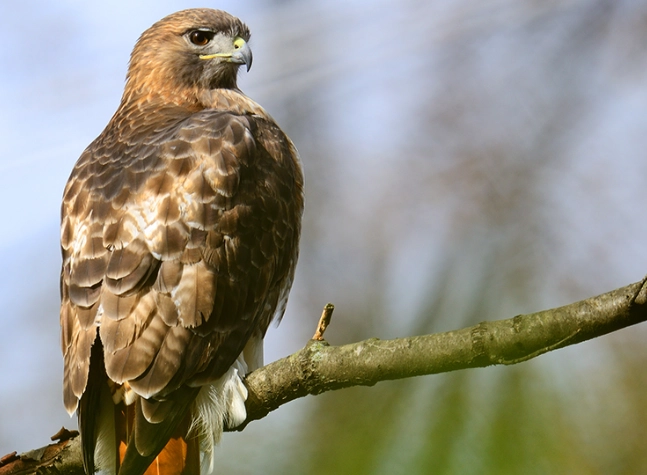
These hawks are masters of adaptation. From the forests of Maine to the deserts of Arizona, they've figured out how to make a home. This guide isn't just a dry list of facts. We're going to dig into what makes these birds tick, how to tell them apart from their look-alikes (a real headache for beginners, trust me), and maybe even help you spot one in your own neighborhood.
Quick Take: The Red-tailed Hawk (Buteo jamaicensis) is the most common and widespread hawk in North America. That piercing, raspy scream you hear in every movie and TV show to signify a wild eagle? That's almost always the call of a Red-tailed Hawk. Hollywood loves them.
What's in a Name? The Red Tail and Other Tell-Tale Signs
So, the name gives the first big clue, right? The red tailed hawk's namesake feature is that rich, rusty-red tail. But here's the kicker – young birds don't have it. Juveniles have brown, banded tails. It takes them about two years to molt into that famous red plumage. I wish more field guides emphasized this. It leads to so much confusion.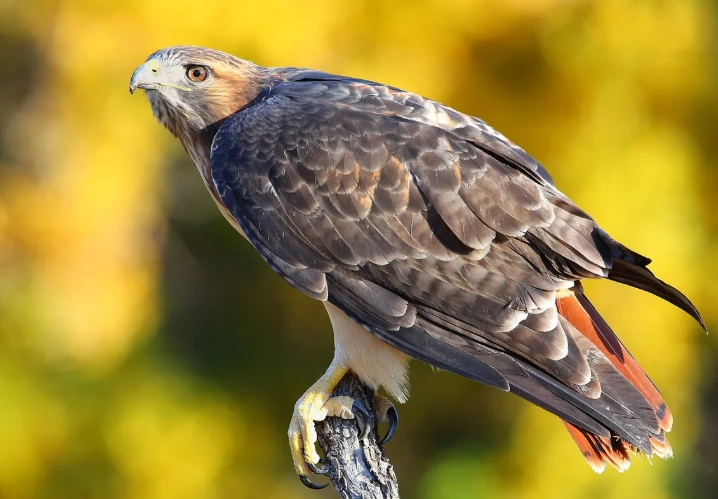
Forget just the tail for a second. Look for the "belly band." This is a key field mark. Most adult Red-tailed Hawks have a streaky band of brown feathers across their white belly. From below, it's a dead giveaway. Their back is usually a dark brown, and when perched, you might see a pale, V-shaped patch on their upper back.
Then there's the size. They're big, chunky birds. Females are larger than males, which is typical for raptors. A big female can have a wingspan pushing four and a half feet. That's a serious bird.
Color Morphs: When a Red Tail Isn't So Red
Just to keep things interesting, Red-tailed Hawks come in different color morphs. The "classic" light morph is what we usually picture. But there are dark morphs, especially out west, where the bird can be almost entirely chocolate brown. The red tail is still there, but you have to look harder. There's even a rare "Krider's" morph that's incredibly pale, almost white. The variety is stunning and can really throw you off if you're not expecting it.
| Morph Type | Primary Coloration | Belly Band Visibility | Common Regions |
|---|---|---|---|
| Light Morph | Dark brown back, white chest/belly | Clear and distinct | Widespread, most common |
| Dark Morph | Dark brown to almost black overall | Absent or very faint | Western North America |
| Krider's Morph | Very pale, whitish head and body | Faint or absent | Great Plains region |
| Rufous Morph | Warm, reddish-brown tones overall | Present, often rufous-tinged | Various, often intermixed |
Where to Find Them: A Hawk in Every Habitat
This is where red tailed hawk hawks truly shine. They are habitat generalists. You name it, they probably live there. Open country is their absolute favorite – think agricultural fields, deserts, grasslands, and parklands. They need some open space to hunt and some scattered trees, fences, or poles to perch on and survey their kingdom.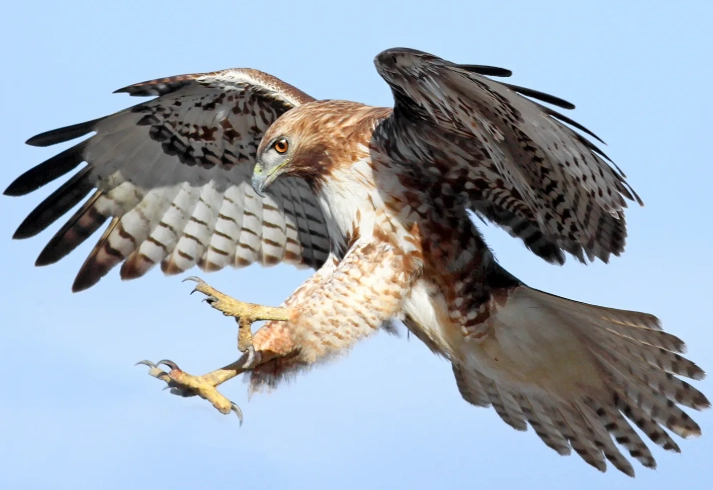
They've also adapted brilliantly to human landscapes. Drive down any interstate highway in the US. See those big birds on the lamp posts? Nine times out of ten, they're Red-tailed Hawks. They use the roadside cuts to hunt rodents that venture into the grass. It's a brilliant, if risky, strategy. I've seen them perched right on the edge of busy freeways, completely unfazed.
They do nest in forests, but usually near a clearing or edge. You won't typically find them deep in unbroken, dense woodland. That's more the realm of the Red-shouldered Hawk, a common source of mix-ups.
The Art of the Hunt: What's on the Menu?
Red-tailed Hawks are opportunistic carnivores. Their diet is a "what's available" special. The primary staple across their range is small mammals. Voles, mice, rats, ground squirrels, and rabbits form the bulk of their meals. They are a farmer's best friend, consuming huge numbers of crop-damaging rodents.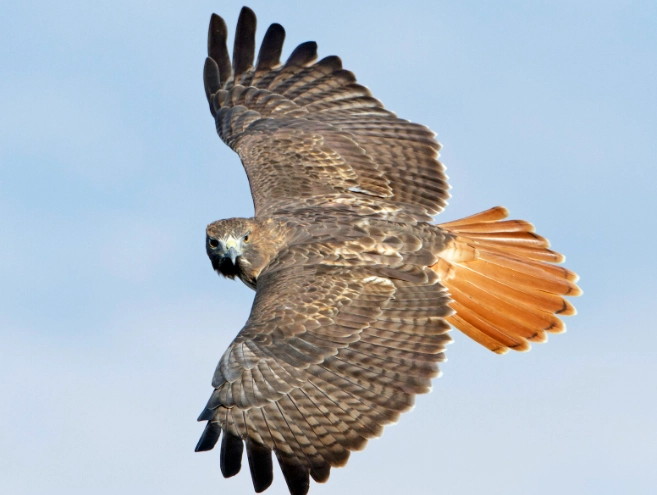
But they're not picky. They'll also take birds (from starlings to pheasants), reptiles (snakes and lizards are fair game), and even the occasional fish or large insect. I once watched one try to grab a gopher snake. It was a ten-minute battle of wills before the hawk finally gave up. The snake lived to slither another day.
Their hunting style is classic "sit-and-wait." They'll perch for hours, perfectly still, just watching. When they spot movement, it's a swift, powerful dive. Their talons are the killing tools. They don't have the lightning-fast aerial agility of a falcon, but from a perch, their power dive is devastatingly effective.
Hunting Hotspots: The best places to watch Red-tailed Hawks hunt are along field edges, where trees meet open grass. Also, check any high, solitary perch with a good view. A dead tree in the middle of a field is prime real estate for a hunting hawk.
How They Eat (It's Not Pretty)
They usually carry their prey back to a favorite perch or, if it's small, eat it on the ground. They tear off bite-sized pieces with their hooked beak. It's a messy affair. You'll often find "plucking posts" – perches littered with fur, feathers, and bones beneath them.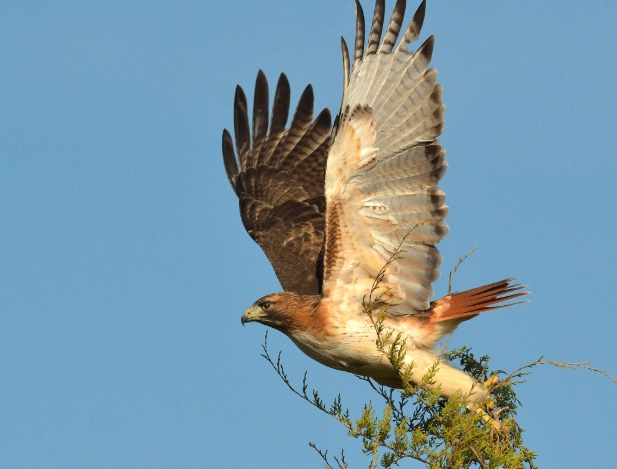
This brings me to a personal gripe. Some people find this part of nature disturbing. They see a hawk with a rabbit and think it's cruel. But it's just life. These hawks are critical for a balanced ecosystem. Without predators like them, rodent populations would explode.
Nesting and Family Life: The Stick Palace in the Sky
Red-tailed Hawks are monogamous and often mate for life, returning to the same territory year after year. Their nests are huge, bulky platforms of sticks, lined with softer bark, greenery, and sometimes even paper or corn husks. They build them high up in the crotch of a tall tree, on a cliff ledge, or increasingly, on human-made structures like cell phone towers or building ledges.
The female does most of the incubating for about a month. The male's job is to bring her food. Once the chicks hatch, it's a non-stop delivery service for both parents. The young hawks, called eyasses, are fluffy white balls of need at first. They grow incredibly fast.
Fledging takes about 6-7 weeks. The young birds are clumsy at first, hopping around branches before their first flight. The parents continue to feed and train them for several weeks after they leave the nest. It's a tough world out there, and juvenile mortality is high. That first year is the hardest.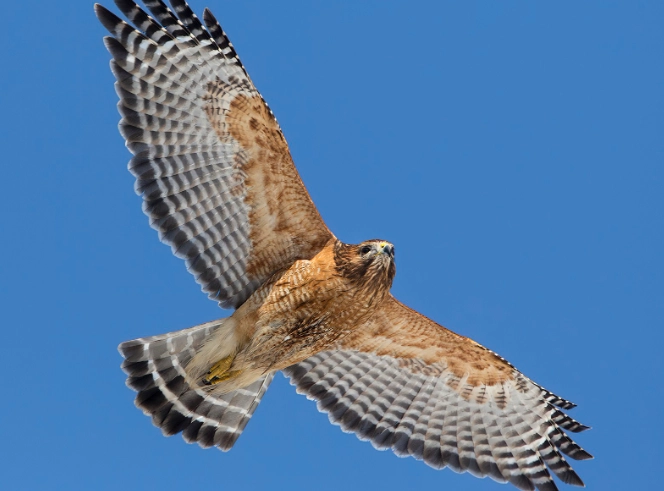
Common Mix-Ups: Is That a Red-Tail?
This is a huge source of questions. People see a big brown bird and call it a Red-tail. Here are the main culprits:
- Red-shouldered Hawk: Slimmer, more colorful. Check for strongly barred reddish underparts and a black-and-white banded tail. Their call is a loud "kee-aah!" very different from the Red-tail's scream.
- Cooper's Hawk & Sharp-shinned Hawk: These are accipiters, built like flying missiles for catching birds. They have long tails rounded at the end, short rounded wings, and a very different flight pattern—a few quick flaps then a glide.
- Rough-legged Hawk: A winter visitor. Look for dark wrists on the underwing and a tail that's white at the base with a dark terminal band. They often hover.
- Turkey Vulture: From afar, a soaring dark bird. But vultures hold their wings in a distinct V-shape (dihedral), rock unsteadily in flight, and have a tiny, red, bald head. In flight, it's an easy distinction once you know it.
My advice? Don't jump to the tail color first. Look at the shape, the flight style, and the belly band.
Frequently Asked Questions About Red Tailed Hawks
Conservation Status and Threats
While still common, red tailed hawk hawks aren't invincible. The widespread use of second-generation anticoagulant rodenticides (SGARs) is a silent killer. A hawk eats a poisoned mouse, and the poison builds up in its own system, causing fatal internal bleeding. It's a horrible, slow death. Supporting regulations on these poisons is a big deal for raptor conservation.
Lead poisoning from ingesting bullet fragments in gut piles left by hunters is another threat. Switching to non-lead ammunition is a huge help. Then there's habitat loss, though they adapt better than most. And of course, vehicle collisions. I've seen too many beautiful birds dead on the side of the road.
On the positive side, legal protection under the Migratory Bird Treaty Act makes it illegal to harm them, their nests, or their eggs without a permit. Public education, like what you're reading right now, also goes a long way.
How to Be a Better Hawk Watcher
Want to see more of these amazing birds? Here's my practical advice, learned from years of getting it wrong before getting it right.
- Look Up, But Also Look Down: Scan the skies for soaring birds, but equally, scan every high perch—light poles, dead tree snags, fence posts, and the tops of power line towers.
- Timing is Everything: Early morning and late afternoon are when they are most active hunting. Midday, they might just be loafing, digesting a meal.
- Listen: Learn their scream. Once you know it, you'll start hearing them everywhere. It's a great way to locate one you can't see.
- Get Decent Binoculars: You don't need to spend a fortune, but a decent pair of 8x42 or 10x42 binoculars will change the game. It lets you see details like the belly band from a distance without disturbing the bird.
- Use a Field Guide or App: I'm old-school and love a physical Sibley or National Geographic guide. But apps like Merlin Bird ID from the Cornell Lab of Ornithology are phenomenal tools, especially for sound ID.
It's a cliché, but the more you look, the more you see. Soon, you'll start noticing the red tailed hawk hawks that were there all along.
Final Thoughts
Red-tailed Hawks are a gateway bird into the world of raptors. They're common, charismatic, and full of fascinating behaviors. They connect us to the wild, even in our most developed spaces. From that iconic scream to that powerful, soaring silhouette, they are a symbol of open skies and wild places.
They're not flashy like a Peregrine.
Not elusive like an owl.
They're the steady, powerful, adaptable workhorse of the North American skies. And that, in my opinion, is something worth watching and protecting. Next time you're on a drive, give those light poles a second glance. You might just be looking at a king.
Reader Comments