You’re walking through an oak forest in late spring, and you hear a distinctive, burry song from the canopy. You look up, expecting maybe a robin or a warbler, and instead, you see a solid, brilliant red bird. Your first thought? "Cardinal." Hold on. Look closer. That bird is sleeker, lacks a crest, and has a heavier, pale bill. Congratulations, you’ve just met the male Summer Tanager, one of North America’s most stunning and underappreciated songbirds.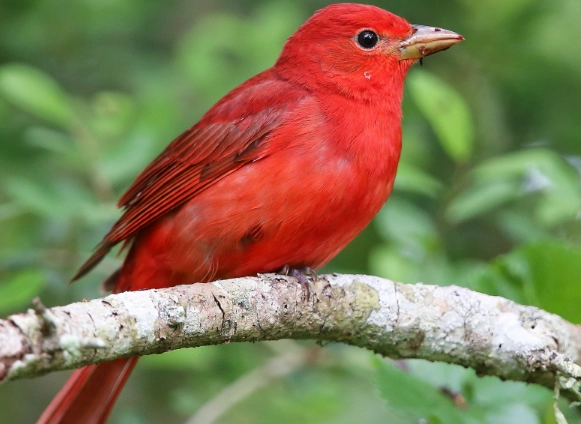
I spent years confusing them with cardinals myself. It wasn’t until I learned to listen that I started seeing them everywhere in their range. This guide isn’t just a rehash of facts from the Cornell Lab of Ornithology (though they’re a fantastic resource). It’s the result of a decade of chasing these birds from Texas to the Carolinas, learning the hard way how to find them, and figuring out the subtle tricks to telling them apart from their lookalikes.
Your Quick Guide to the Summer Tanager
How to Spot a Summer Tanager (And Avoid the Cardinal Mistake)
This is the biggest hurdle for new birders. Let’s break it down so you never second-guess yourself again.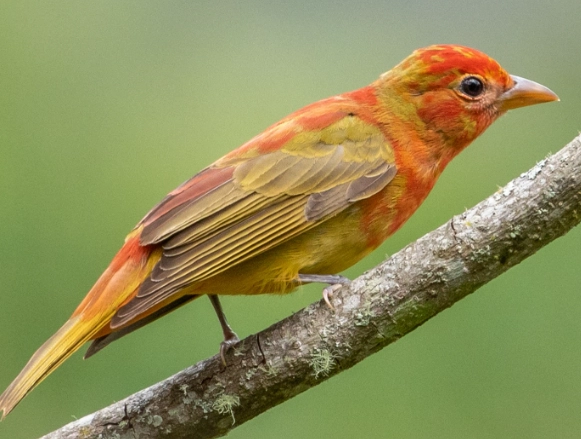
The Male: Rosy Red, Not Fire Engine
A male Summer Tanager is a uniform, rosy-red or orange-red. It’s not the stark, vivid crimson of a Northern Cardinal. Think of a ripe strawberry versus a stop sign. The lack of a crest is the dead giveaway. Its body is smooth and streamlined. The bill is hefty and pale, almost ivory-colored, not the stout, orange-red cone of a cardinal.
Here’s a mistake I see constantly: people spot a red bird with black wings and call it a tanager. That’s a Scarlet Tanager, a different species entirely. The male Summer Tanager never has black wings. It’s all red.
The Female and Immature: The Ultimate Camouflage
If males are tricky, females and first-year males are a real test. They are a mustard-yellow to olive-green, sometimes with faint orange patches. They can look incredibly similar to female orioles or even some vireos. The key is the bill—that same large, pale, slightly hooked bill. No other common yellowish bird in its range has a bill like that.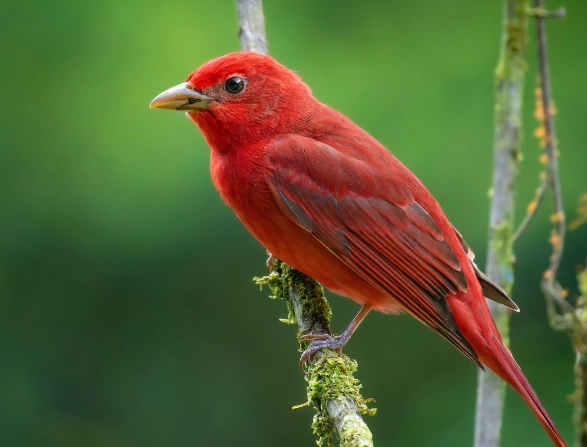
Pro Tip from the Field: Don’t just rely on color. In dappled light, color is unreliable. Always check the silhouette: no crest, a stout pale bill, and a relatively long tail. If it’s a yellowish bird high in a tree methodically moving along branches, give that bill a hard look.
Sound is Your Best Clue
Honestly, I find more Summer Tanagers by ear than by eye. Their song is a series of short, musical phrases, often described as robin-like but burrier, more slurred. It’s not as flute-like as a Wood Thrush. The most common call is a sharp, distinctive "pik-i-tuck-i-tuck" or a dry, rattling "chi-ti-tuck." Once you learn it, you’ll start hearing it everywhere in appropriate habitat. I recommend listening to recordings on the Macaulay Library website to get the sound in your head.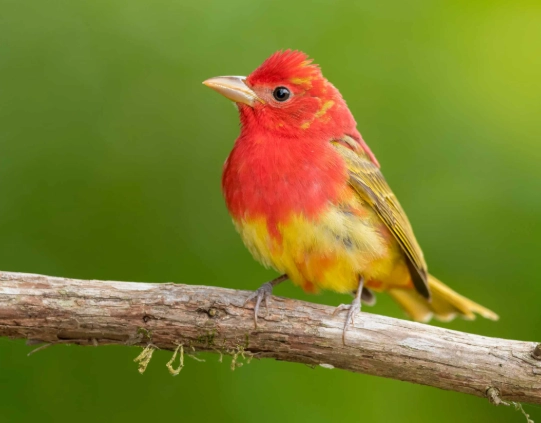
| Feature | Male Summer Tanager | Male Northern Cardinal | Male Scarlet Tanager |
|---|---|---|---|
| Body Color | Rosy-red, uniform | Vivid crimson, uniform | Vivid red with jet-black wings and tail |
| Crest | No crest | Prominent pointed crest | No crest |
| Bill | Pale, heavy, slightly hooked | Orange-red, stout, conical | Silver-gray, smaller |
| Key Sound | Burry "pik-i-tuck-i-tuck" | Whistled "cheer cheer cheer" | Hoarse, robin-like phrase |
Where and When to Find Summer Tanagers
These birds are neotropical migrants, spending winters from central Mexico to northern South America. They come to the United States strictly for the breeding season.
Range: Primarily the southeastern and south-central U.S. Think from central New Jersey west to southern Iowa, and south all the way to Florida and the Gulf Coast into Texas. They’re absent from the far Northeast and most of the Midwest.
Timing is Everything: They arrive later than many migrants. Don’t expect to see one in Georgia in early March. Mid-April to early May is when they really start showing up in force. They stick around until September, sometimes into early October.
Habitat, Not Just Geography: You can be in the perfect state and still miss them if you’re in the wrong spot. They are birds of open, mature deciduous or mixed forests. I’ve had the most luck in:
- Upland oak and pine forests.
- Riparian corridors (forests along rivers and streams).
- Open woodlands with a high, open canopy.
- They generally avoid dense, unbroken forest and wide-open fields.
Last May, I found a reliable pair in a specific stretch of post-oak woodland near a creek in central Texas. They returned to the same 10-acre patch for three years running. It’s about finding those specific, sunny, open-woodland pockets.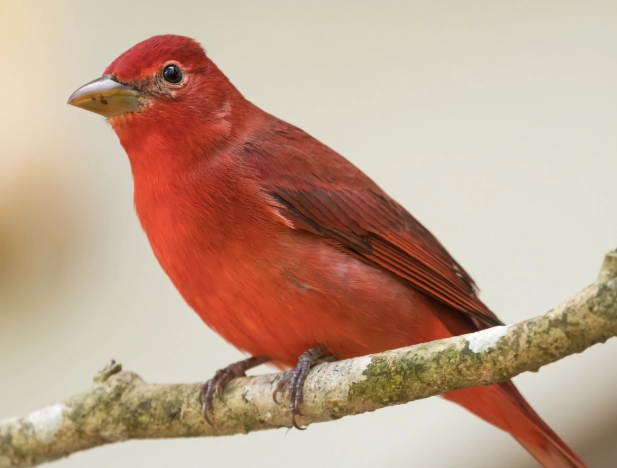
Bee-Eaters and Songsters: Unique Tanager Behavior
Summer Tanagers have a fascinating diet that sets them apart. They are famous for being "bee-eaters." They snatch bees and wasps out of the air or pluck them from flowers. They beat the insect against a branch to remove the stinger before eating it. This is a huge ecological service. I’ve watched one clear out a paper wasp nest over a week, methodically reducing the population.
They also eat other insects and, later in summer, plenty of berries and fruits.
Their nesting strategy is clever. The female builds a shallow, cup-shaped nest remarkably high in a tree, often on a horizontal branch far from the trunk. It’s so flimsy you can sometimes see light through the bottom. This placement, combined with her excellent camouflage, makes the nest incredibly hard to find. I’ve only ever found two.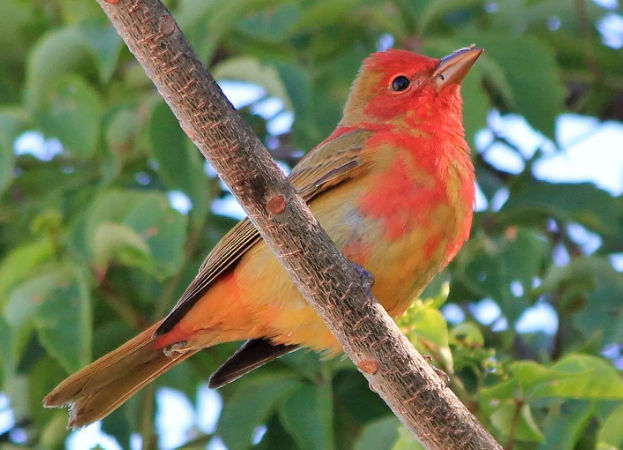
Can You Attract a Summer Tanager to Your Yard?
This is the million-dollar question. Summer Tanagers are not typical backyard birds like chickadees or finches. They are wary and prefer natural, wooded settings. You won’t attract them with a standard tube feeder full of sunflower seeds.
But you can make your property inviting. The key is to think like a tanager.
- Plant Native Trees and Shrubs: Oak trees are a magnet. They support countless caterpillars (baby bird food) and provide acorns later. Also plant serviceberry, mulberry, and dogwood for their fruits.
- Provide a Water Source: A birdbath, especially a dripper or mister, can be a powerful draw. They need to drink and bathe.
- Stop Using Pesticides: This is non-negotiable. If you kill all the bees, wasps, and caterpillars, you have removed the tanager’s primary food source. Let a few wasps live; the tanagers will handle them.
- Offer Fruit: In late summer, you might entice one with orange halves or overripe berries placed on a platform feeder. It’s a long shot, but it works for some people in wooded suburbs.
I have a friend in South Carolina whose yard borders a forest. She never sees tanagers at her feeders, but a pair nests in her oaks every year because she has a pesticide-free yard full of native plants. That’s the real secret.
Summer Tanager FAQs: Expert Answers
The Summer Tanager is a bird that rewards patience and careful observation. It’s not the flashiest at a feeder, but spotting that rose-red male in a sunlit oak or finally distinguishing the buzzy song from the chorus of a spring forest is a real thrill. Grab your binoculars, head to a nearby open woodland this May, and listen. That burry call is your invitation to look up.
Reader Comments