If you've ever found yourself wondering, "What is the difference between a robin and an American Robin?", you're in incredibly good company. I've lost count of the number of times I've had this conversation at birdwatching meetups or even with friends just starting to notice the birds in their backyard. The mix-up is so common it's almost a rite of passage for budding birders. One is a classic symbol of Christmas in Europe, popping up on cards and wrapping paper. The other is that cheerful, worm-pulling herald of spring across North American lawns. They share a name, sure, but that's about where the similarities start to get really, really fuzzy.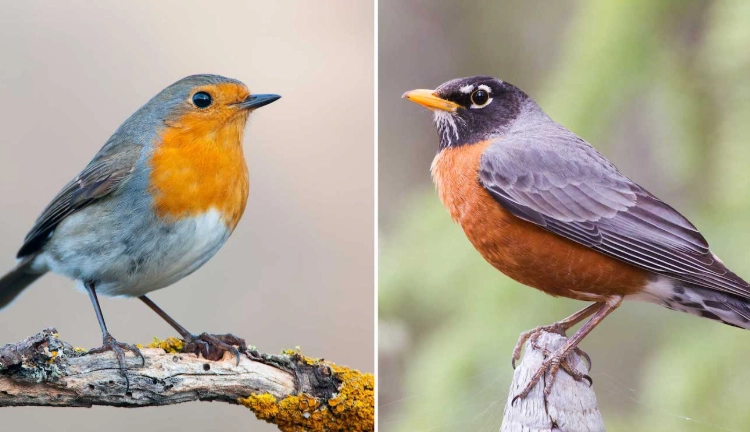
In This Guide
- Side-by-Side: The Quick Snapshot
- Digging Deeper: Taxonomy and Family Ties (Or Lack Thereof)
- Home Turf: Habitat and Where You'll Find Them
- Dinner Time: Diet and Foraging Behavior
- The Soundtrack: Songs and Calls
- Behavior and Life Cycle: From Courtship to Fledglings
- Frequently Asked Questions (The Stuff People Really Want to Know)
- Conservation Status
Honestly, I made the same mistake myself years ago. I grew up with American Robins, then saw a picture of the European bird and thought, "Wait, that's not a robin! That's something else entirely." It was my first real lesson in how common names can be misleading. It's not just a minor detail for hardcore bird nerds either. Getting them confused can lead to misreporting sightings in citizen science apps, misunderstanding migration patterns, or just plain missing out on appreciating two truly unique and fascinating species. So let's settle this. Let's dig into the real story behind these two birds and clear up the confusion for good.
The Core Confusion: The name "robin" was given by homesick European settlers in North America. The bird they saw (our American Robin) had a similar reddish-orange breast to the familiar bird back home, so they called it a robin too. Biologically, however, they are about as closely related as a dolphin and a shark—similar in some ways due to their environment, but from completely different branches of the family tree.
Side-by-Side: The Quick Snapshot
Before we dive into the nitty-gritty, here's a table that lays out the most immediate differences. This is the cheat sheet I wish I'd had when I started.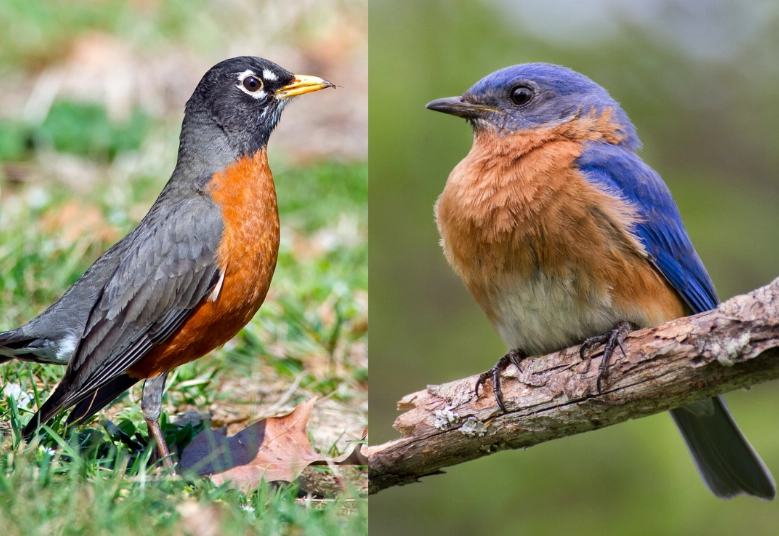
| Feature | European Robin (Erithacus rubecula) | American Robin (Turdus migratorius) |
|---|---|---|
| Family | Old World Flycatchers (Muscicapidae) | Thrushes (Turdidae) |
| Size & Build | Small, plump, round. Sparrow-sized. | Large, sleek, athletic. Nearly blackbird-sized. |
| Color Pattern | Orange-red face and breast, with a clear, sharp border against grey-brown upperparts and off-white belly. | Darker brick-red to orange breast, blending into a white throat with black streaks and a grey-brown to blackish back. |
| Legs & Posture | Often seen perched upright. Thin, dark legs. | Often seen standing alert on the ground. Strong, yellowish legs. |
| Typical Habitat | Woodlands, gardens, hedgerows. Shy and often close to cover. | Lawns, parks, open woodlands, suburbs. Bold and often in open spaces. |
| Song | Fast, delicate, melancholic warble. A winter songster. | Rich, musical, repetitive phrase: "cheerily, cheer up, cheer up, cheerily." A dawn chorus staple. |
See? Even at a glance, they're different beasts. But a table only scratches the surface. To really understand what is the difference between a robin and an American Robin, we need to look closer.
Digging Deeper: Taxonomy and Family Ties (Or Lack Thereof)
This is where the science gets interesting and really explains the root of their differences. It's all about family.
The European Robin belongs to the family Muscicapidae, the Old World flycatchers and chats. Its close relatives include birds like the Nightingale and the Common Redstart. They're generally small, insect-eating birds known for their agility and often beautiful songs. The scientific name Erithacus rubecula hints at its solitary, ground-loving nature.
The American Robin, on the other hand, is a proud member of the Turdidae family—the thrushes. This is a big deal. Its cousins include the majestic Wood Thrush, the Hermit Thrush, and even the Eastern Bluebird (yep, bluebirds are thrushes!). Thrushes are typically medium-sized, have strong legs for ground-foraging, and many are famous for their flute-like, echoing songs. The American Robin's scientific name, Turdus migratorius, literally means "migratory thrush," which tells you a lot about its behavior.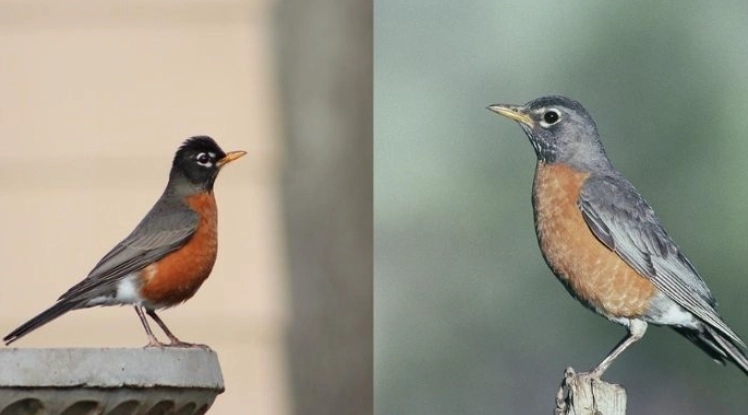
Why This Matters: Family determines so much about a bird's blueprint: its bone structure, its digestive system, its song-producing anatomy (the syrinx), and its instinctive behaviors. An American Robin behaves like a thrush because it is a thrush. A European Robin acts like a chat because it is a chat. This fundamental split is the number one answer to what is the difference between a robin and an American Robin.
A Tale of Two Bodies: Size, Shape, and Fine Details
Let's get visual. If you put them next to each other, the size difference would be laughably obvious.
The European Robin is tiny. I mean, really quite small. It's only about 12.5–14.0 cm (5–5.5 inches) long and weighs a mere 16–22 grams. That's lighter than a AA battery. It has a very rounded body, almost like a feathered ball, with relatively short wings and tail. Its most striking feature is that vivid orange-red patch that covers its face, throat, and breast, with a very neat, almost painted-on line separating it from the greyish-brown back and whitish lower belly. Its eyes are large and dark, giving it an inquisitive look.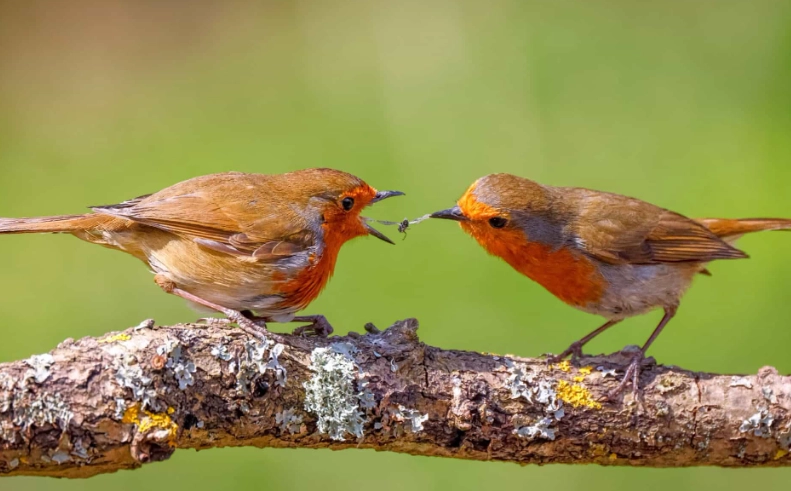
Now, the American Robin is a substantially heftier bird. It measures 23–28 cm (9–11 inches)—that's nearly twice as long—and weighs a solid 77–85 grams. It has the classic thrush shape: longer, more streamlined body, a longer tail, and a more upright posture when alert. Its red breast is a deeper, richer brick-red or orange, and it doesn't have that clean-cut border. Instead, the red blends into a white throat that's heavily streaked with black, and its back is a uniform grey-brown. The bill is yellow with a dark tip, and those legs are a distinctive pale yellow-brown, perfect for striding across your lawn.
A quick personal aside: I once showed a photo of an American Robin to a friend from the UK. Her first reaction was, "Goodness, your robins are so... serious looking! Ours look cute and cuddly." I think she nailed it. The American Robin has a sterner, more purposeful expression, while the European Robin has that classic "friendly garden bird" vibe.
Home Turf: Habitat and Where You'll Find Them
This is another huge divider. Their preferred hangouts tell you a lot about their personalities.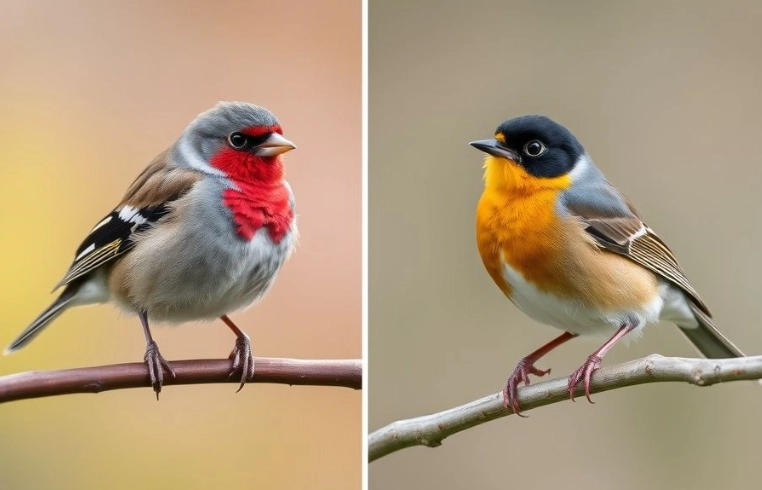
The European Robin is a creature of the understory. It loves dense, shaded woodlands, overgrown hedgerows, and quiet, leafy gardens. It's often described as "confiding but shy"—it might come quite close to a gardener turning over soil, but it stays near the safety of a bush or a log pile. You'll rarely see one out in the middle of a wide-open field. It's a bird of edges and cover. According to the Royal Society for the Protection of Birds (RSPB), they are fiercely territorial, with both males and females holding territories in winter, which is quite unusual.
The American Robin is practically the poster child for suburban and open-country birding. It thrives on lawns, in parks, on golf courses, in agricultural fields, and in open woodlands. It's bold and comfortable in wide-open spaces. While they do perch in trees (especially for nesting and singing), a huge part of their life is spent hopping and running on the ground, head cocked, listening for earthworms. They're highly gregarious outside of breeding season, forming massive flocks that can number in the thousands, something you'd never see with the solitary European Robin. The Cornell Lab of Ornithology's All About Birds guide notes they are one of the most widespread and adaptable birds in North America.
Habitude Clash: Imagine a European Robin trying to forage on an American suburban lawn. It would likely feel terribly exposed and vulnerable. An American Robin in a dense European hedgerow might seem clumsy and out of place. Their habitats shaped their evolution.
Dinner Time: Diet and Foraging Behavior
Both eat insects and fruit, but the proportions and techniques are different.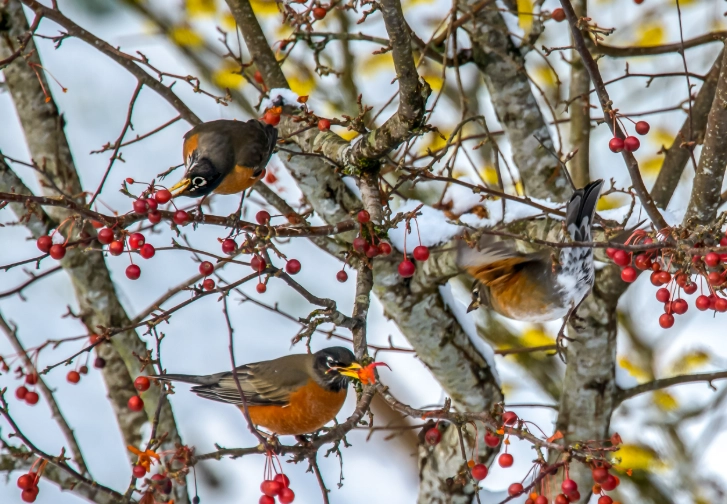
European Robins are primarily insectivores. They eat beetles, spiders, worms, and other invertebrates, which they glean from leaves, dig from soft ground, or even catch in short aerial sallies (that flycatcher heritage showing through). In winter, they switch more to berries and fruits. They're classic "perch-and-pounce" hunters, watching from a low branch before dropping down.
American Robins are the famous worm-pullers. Their diet is more seasonal. In spring and summer, it's heavily weighted towards earthworms and insects, which they find by sight (not by hearing, a common myth—they cock their head to see better). In fall and winter, they switch almost entirely to fruits and berries—cedar waxwings, and robins can strip a holly or juniper tree clean in hours. They forage mostly on the ground, using a run-stop-tilt method, but will also feed in trees on fruit.
The Soundtrack: Songs and Calls
Close your eyes. This is one of the surest ways to tell them apart.
The song of the European Robin is something special. It's a fast, tinkling, slightly melancholic warble, full of high notes and trills. It's often described as "sweet but sad." What's fascinating is that they sing year-round, even on short winter days, defending their feeding territories. Their call is a sharp, ticking "tic-tic-tic" or a thin, high-pitched "see." You can listen to excellent recordings on the Xeno-canto database.
The American Robin's song is an iconic sound of North American spring. It's a series of clear, whistled phrases, often repeated in a pattern: "cheerily, cheer up, cheer up, cheerily." It's loud, confident, and carries far. They sing primarily at dawn and during the breeding season. Their call is the familiar, rapid, laughing "tut-tut-tut" or a sharp, piercing "yeep!" alarm call when a cat or hawk is near. Cornell's Macaulay Library is a treasure trove of their vocalizations.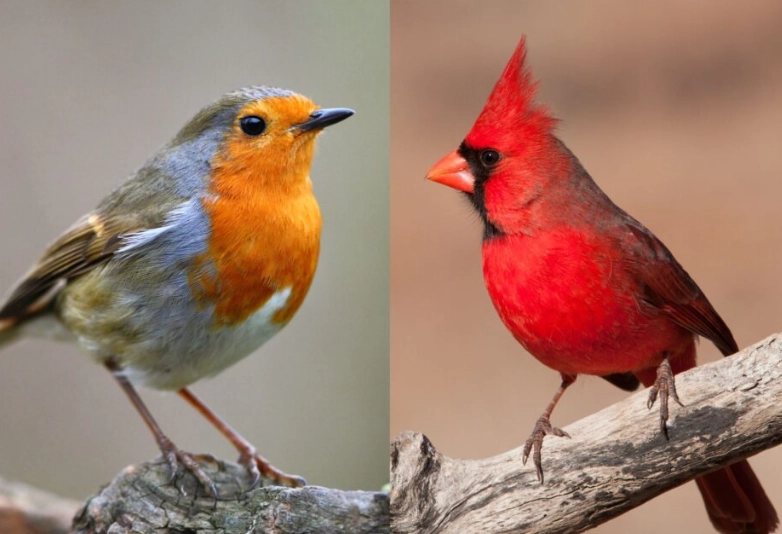
I find the European Robin's song more complex and interesting to listen to closely, but there's nothing like the cheerful, predictable caroling of an American Robin on a April morning to make you feel like winter is finally over. The American Robin's song feels optimistic; the European Robin's feels thoughtful.
Behavior and Life Cycle: From Courtship to Fledglings
Territory and Temperament
European Robins are famously territorial and solitary outside of the breeding pair bond. Males and females will fight intruders of the same sex ferociously. They are also known for their curiosity towards humans in gardens, a trait that has made them a cultural icon.
Nesting
European Robins build a neat, cup-shaped nest of leaves and moss, well-hidden in a crevice, a hole in a bank, or even in garden tools left in a shed. They are masters of concealment.
Migration
Many European Robins are partial migrants. Birds in colder northern Europe may move south or west, while many in the UK and milder parts are resident. Their migration is less dramatic.
American Robins are famous for their large-scale, nomadic migrations. While some may stay put in mild areas, most populations move south in winter and north in summer, often in massive flocks. Their arrival is a true sign of spring for many. The National Audubon Society's guide has great maps showing this movement.
Pro Tip for Birders: If you're in North America and see a small, robin-like bird with a red breast, think Eastern Towhee (larger beak, white belly) or a Spotted Towhee (spots on wings). In Europe, a bird that might briefly confuse you is the Redstart (has a red tail). Context is everything!
Frequently Asked Questions (The Stuff People Really Want to Know)
Conservation Status
Here's some good news. Both species are doing well, which is a relief. According to the IUCN Red List, both the European Robin and the American Robin are classified as Least Concern. Their populations are large, stable, and they have adapted brilliantly to human-altered landscapes like suburbs, farms, and gardens. The American Robin's adaptability is particularly impressive, thriving from Alaska to Florida.
The Final Word: So, what is the difference between a robin and an American Robin? It's the difference between a small, secretive forest insectivore and a large, gregarious open-country thrush. They are different in family, size, shape, color pattern, song, behavior, and habitat. The shared name is a historical accident, a footnote from the age of exploration. The shared red breast is a beautiful coincidence of evolution.
Understanding this distinction does more than just win you points in a trivia game. It deepens your appreciation for both birds. You start to see the American Robin not just as a common lawn bird, but as a rugged, migratory thrush with a complex social life. You see the European Robin not just as a Christmas card icon, but as a fiercely territorial, year-round songster of the woodland shadows. They're both wonderful. They're just wonderful in completely different ways.
Next time someone asks you about the difference, you can tell them the whole story. And maybe save them from the same confusion we've all had to work through. Now, go listen. You'll never hear them the same way again.
Reader Comments