In This Guide
- Unmistakable Identification: The One Feature You Must Know
- Not Just a Pretty Face: The Behavior of a Female Downy
- Life Cycle and Nesting: The Lady of the House
- Habitat and How to Attract a Female Downy to Your Yard
- Common Questions About the Female Downy Woodpecker
- Conservation Status: A Common Success Story (For Now)
You see a little black-and-white woodpecker tapping away at a tree branch. It's small, cute, and busy. Is it a Downy Woodpecker? Almost certainly. But is it a male or a female Downy Woodpecker? That's where a lot of us get stuck. The male gets all the flashy press with that bright red patch on the back of his head. The female Downy Woodpecker, though? She's the master of subtlety. And honestly, once you learn her tells, she becomes just as fascinating—maybe more so, because you have to look a little closer.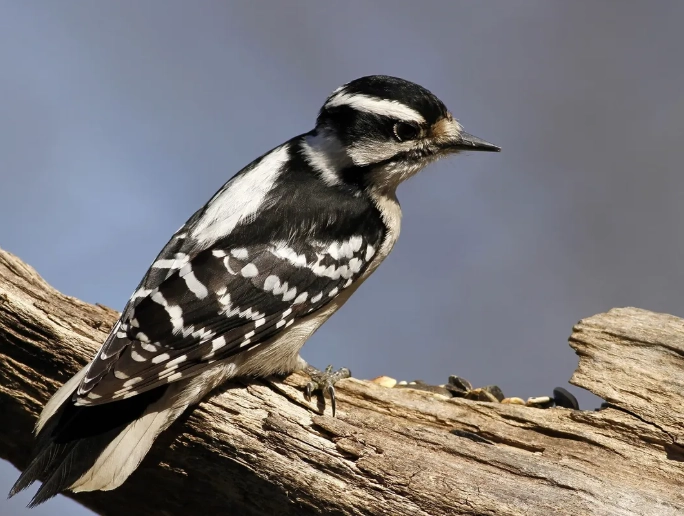
I remember spending ages in my own backyard, binoculars glued to my face, trying to figure out if I was looking at a female Downy or a young male whose red hadn't come in yet. It was frustrating. Field guides just show you perfect side-by-side drawings. Real birds are moving, hiding behind leaves, and aren't always in perfect light. This guide is what I wish I'd had back then. We're going deep on the female Downy Woodpecker, from the single key feature that gives her away to what she's like when no one's watching.
Unmistakable Identification: The One Feature You Must Know
Let's cut right to the chase. Forget complicated patterns for a second. There is one dead-simple, fail-safe rule for identifying a female Downy Woodpecker.
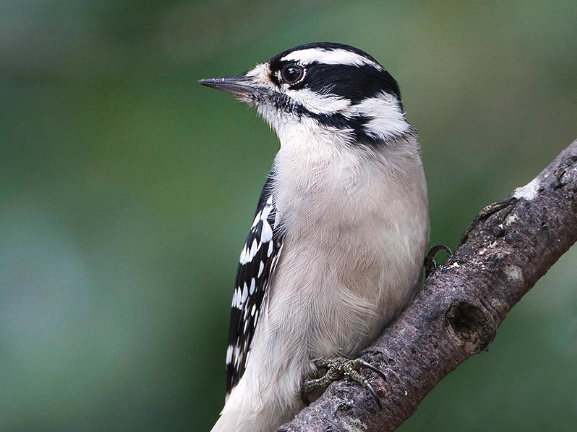
If it's a Downy Woodpecker and it has no red markings at all on its head, it's a female.
That's it. That's the golden rule. The male has a bright red nape patch (a small, rectangular-ish patch on the very back of its head). The female Downy Woodpecker lacks this entirely. Her head is strictly a stylish combination of black and white. This holds true for adults all year round. Juvenile males might have a bit of red on their crown (top of the head), but it's patchy and forward, not the neat nape patch of an adult male. A clean, all-black-and-white head on a woodpecker of this size? You've found your girl.
Quick Size Reference: A Downy Woodpecker is tiny for a woodpecker, about the size of a sparrow (6-7 inches long). This is your first clue it's a Downy and not its larger, nearly identical cousin, the Hairy Woodpecker. If it's sparrow-sized and pecking wood, you're in Downy territory.
Beyond the Missing Red: A Detailed Look at Her Plumage
Okay, so she has no red. But what does she have? Her plumage is a masterpiece of practical camouflage. The back is solid black, which helps her blend into tree bark shadows. Running right down the center of that black back is a broad, crisp white stripe. When she's clinging to a tree trunk, this stripe can look like a sliver of sunlight.
Her wings are black with rows of white spots that form what look like checkered bars across the folded wing. The outer tail feathers are pure white with a few black bars or spots—these are really obvious when she flies. The underparts are plain white, from the chin all the way down. Her face is striped: a bold black stripe runs from the beak, through the eye, and connects to the black on the back of the neck. Right above this is a prominent white stripe (the supercilium), and another white stripe runs below the cheek.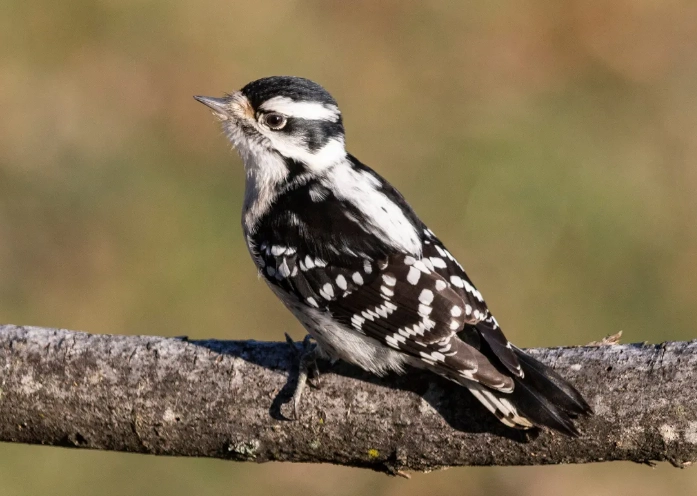
The bill is short, sturdy, and dagger-like, perfect for her insect-hunting work. It's blackish-gray. Honestly, her whole look is sleek, efficient, and no-nonsense. It screams "working professional."
Side-by-Side: Female vs. Male Downy Woodpecker
A table makes this crystal clear. This is the comparison you'll use in the field.
| Feature | Female Downy Woodpecker | Male Downy Woodpecker |
|---|---|---|
| Head Pattern (Key ID) | Entirely black and white. No red markings whatsoever. | Has a distinct, small, bright red patch on the nape (back of head). |
| Overall Vibe | Subtle, camouflaged, understated elegance. | Same, but with that one flashy accent piece on the head. |
| Behavior | Identical in foraging and most activities. Some studies suggest slight differences in preferred foraging heights. | Identical. The red patch plays no role in feeding. |
| Voice & Drumming | Identical. Both sexes call and drum to communicate and claim territory. | Identical. |
See? Apart from that one patch of red, they are twins. This similarity is why focusing on the head is non-negotiable for telling a female Downy Woodpecker apart.
Not Just a Pretty Face: The Behavior of a Female Downy
This is where the female Downy Woodpecker really shines. She's not just a muted version of the male; she's a fully capable, industrious bird with her own rhythm. A lot of bird info glosses over the female's role, treating her as a passive nest-sitter. That's not the Downy way.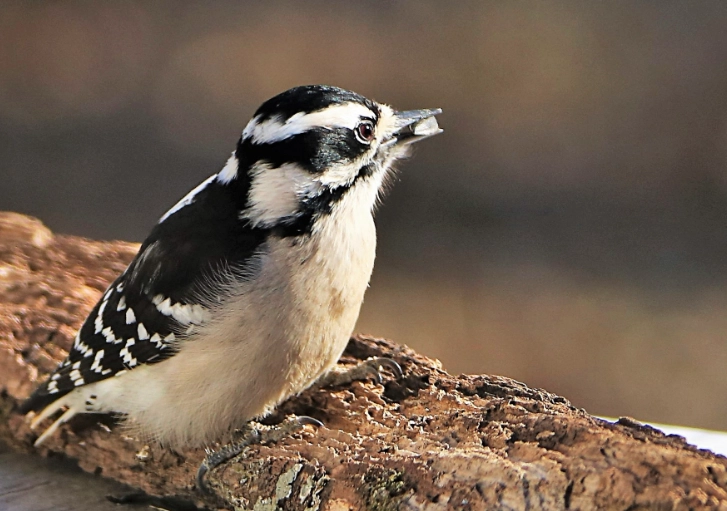
Foraging: The Insect Specialist
Watch a female Downy Woodpecker work a tree, and you'll see an expert in action. She uses her stiff tail feathers as a prop, hitching herself up and down branches with a jerky, gymnastic motion. Her primary food is insects and their larvae—beetles, ants, caterpillars, even the dreaded emerald ash borer. She uses her chisel-like bill to peck, pry, and probe into crevices in the bark.
Here's a cool thing: studies, like those referenced by the Cornell Lab of Ornithology, suggest that males and females might slightly partition their foraging to reduce competition. Males tend to forage more on smaller branches and twigs, while females might spend more time on larger branches and trunks. It's not a hard rule you can always see in your backyard, but it shows they have their own subtle strategies. The female Downy Woodpecker is a key player in natural pest control.
She also loves suet. If you have a suet feeder, you'll see her. She'll often cling to the cage, pecking away determinedly. She's less skittish than some birds and might tolerate you watching from a window a few feet away.
Drumming and Calling: She Makes Noise Too
A big misconception is that only male woodpeckers drum. Not true. Both the female and male Downy Woodpecker drum. Drumming is that rapid, machine-gun-like pecking on a resonant surface (a hollow branch, a gutter, sometimes your siding—sorry). It's not about feeding; it's about communication. They drum to announce territory and to communicate with their mate.
Her call is a sharp, high-pitched "pik!" or a descending whinny/rattle series. You'll hear the female Downy Woodpecker giving these calls year-round to stay in contact with her mate or to sound an alarm. Her voice is indistinguishable from the male's to our ears.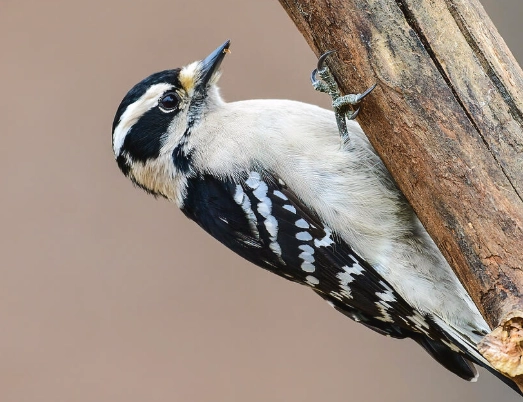
Life Cycle and Nesting: The Lady of the House
This is the domain where the female Downy Woodpecker is utterly essential. The pair works together, but she has the lead role in one critical phase.
The Nest Site: A Team Effort
Downys are cavity nesters. They don't use old nests; they excavate a new one each year, usually in a dead tree or a dead limb of a live tree (soft wood is easier to dig into). Both the male and female scout for the perfect spot. Once they choose it, both birds share in the excavation. They take turns chiseling away, creating a perfectly round entrance hole about 1-1.5 inches across, leading to a cavity about 6-12 inches deep. This can take a week or two of hard labor.
Eggs and Incubation: Her Primary Duty
Here's where her full-time job begins. The female Downy Woodpecker lays a clutch of 3-6 pure white eggs. She is the one who does the majority of the incubation, sitting on those eggs for about 12 days to keep them warm and safe. The male does take shifts, often incubating during the day so she can go feed, and he always takes over at night, roosting in the cavity. But the bulk of this sensitive, sedentary work falls to her.
Raising the Young: A Hustling Partnership
Once the naked, helpless chicks hatch, both parents go into overdrive. The feeding demands are insane. Both the female and male Downy Woodpecker are in constant motion, catching insects and bringing them back to the cavity to stuff into hungry mouths. This goes on for about 20-30 days until the fledglings are ready to leave the nest.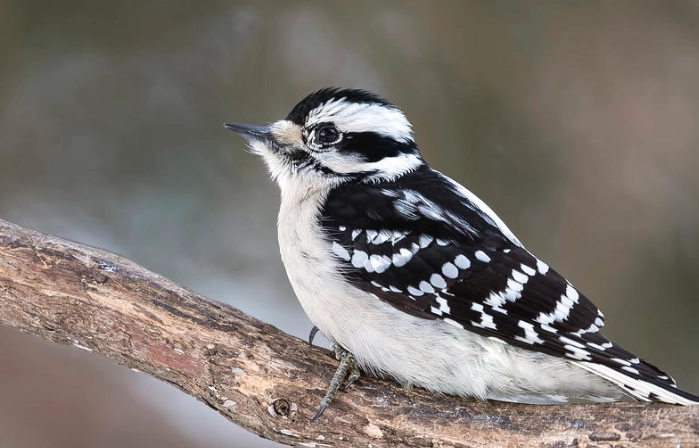
Even after they fledge, you might see the family together for a short while, the parents still feeding the clumsy young birds. You can spot the juveniles—they look a bit scruffy, and the young males will have that patchy red on the crown, not the nape. The female fledglings will look like smaller, slightly less crisp versions of their mom from the start.
For authoritative details on nesting timelines and behaviors, resources like the Audubon Field Guide are invaluable.
Habitat and How to Attract a Female Downy to Your Yard
Want to see a female Downy Woodpecker up close? You're in luck. She's one of the most adaptable and common backyard woodpeckers across North America. According to range maps from the Cornell Lab, she's found from Alaska and Canada all the way down to Florida, absent only from the driest deserts and the far north tundra.
She likes edges—where woods meet fields, orchards, parks, and yes, suburban backyards with a few mature trees. If you have trees, you have a chance.
Here’s what specifically makes your yard a female Downy Woodpecker magnet:
- Leave Dead Wood: If it's safe (not about to fall on your house), leave a dead tree or a few dead limbs. This is her supermarket (insects) and her potential housing development (nest sites). This is the single best thing you can do.
- Offer Suet: She loves suet, especially in winter. A simple cage feeder does the trick. In summer, consider "no-melt" suet blends.
- Try Peanut Butter: Smear some peanut butter (natural, no xylitol!) on a pinecone or in a log with holes drilled in it. It's like woodpecker candy.
- Black Oil Sunflower Seeds: While she's not a big seed-eater at feeders, she might visit a tube or platform feeder for these, especially if they're easily accessible.
- Water Source: A birdbath, especially one with a dripper or mister, is a huge draw. All birds need to drink and bathe.
- Go Natural on Pesticides: The fewer chemicals you spray, the more insect prey she'll find. Let her be your pest control.
I put up a suet feeder five years ago. The first visitor was a male Downy. But within a day, his mate showed up—a classic female Downy Woodpecker, no red in sight. Now, I see her every single day, winter or summer. She's part of the garden crew. She even brings her kids around in the summer.
Common Questions About the Female Downy Woodpecker
Conservation Status: A Common Success Story (For Now)
It's a relief to talk about a bird that isn't in immediate crisis. According to the U.S. Fish & Wildlife Service and population surveys, the Downy Woodpecker is widespread and common. Its population is considered stable, even increasing slightly in some areas. Their adaptability to human-altered landscapes (like our backyards) is a big reason for this success.
But stability isn't a guarantee. They still rely on trees—dead trees for nesting, live trees for food. Large-scale removal of dead wood ("sanitizing" forests) and the overuse of insecticides harm their food supply. The best thing we can do for the female Downy Woodpecker and her family is to provide pockets of good habitat, right where we live.
So next time you're out, listen for that sharp "pik!" or the rat-a-tat-tat of a small woodpecker. Take a second look. If that busy little black-and-white bird has a clean, red-less head, smile and say hello. You've just met one of the hardest-working, most subtly beautiful residents of the woods—the female Downy Woodpecker.
Reader Comments