So, you're curious about the cactus wren? Maybe you heard its loud, raspy chatter on a hike in Arizona or saw a picture of its ridiculous, football-sized nest. You're not alone. This bird is a character, a true icon of the American Southwest that somehow manages to be both comical and fiercely impressive.
I remember the first time I really noticed one. I was in the Sonoran Desert, trying to enjoy the quiet, when this brash, striped bird hopped onto a cholla cactus right next to the trail. It gave me a sideways look, scolded me with a series of harsh char-char-char sounds, and then proceeded to poke around the cactus spines like they were nothing. No fear. That's the cactus wren in a nutshell.
This isn't going to be a dry, textbook entry. Think of it as a chat with someone who's spent too much time watching these birds and has come to appreciate their weird, wonderful ways. We'll cover everything you could possibly want to know—what they look like, where they live, how they build those insane nests, what they eat, and even how you might convince one to visit your backyard if you live in the right place.
Quick Navigation
- What Exactly Is a Cactus Wren?
- Spotting One: A Breakdown of the Cactus Wren's Look
- Home Sweet (Spiky) Home: Cactus Wren Habitat
- The Master Builder: Inside the Cactus Wren Nest
- A Day in the Life: Cactus Wren Behavior and Diet
- The Sound of the Desert: Cactus Wren Calls and Songs
- Family Life: From Eggs to Fledglings
- Cactus Wrens and People: Backyard Friends?
- Are They in Trouble? Conservation Status
- Final Thoughts: Why This Bird Matters
- Your Cactus Wren Questions, Answered
What Exactly Is a Cactus Wren?
Let's start with the basics. The cactus wren (Campylorhynchus brunneicapillus) is the largest wren found in the United States. It's not some delicate little songbird. It's stout, bold, and built for a harsh life. It's the state bird of Arizona, which tells you a lot about its personality—tough, adaptable, and impossible to ignore.
It belongs to the wren family (Troglodytidae), which is full of energetic, insect-loving birds. But the cactus wren is like the family's rugged cousin who moved out to the desert and developed a unique set of survival skills.
Fun (and telling) fact: Its scientific name, Campylorhynchus brunneicapillus, gives clues about it. "Campylorhynchus" means "curved bill," which it has, perfect for probing into crevices. "Brunneicapillus" means "brown-haired," referring to its brown cap. Even the scientists named it for its tools and its looks.
Spotting One: A Breakdown of the Cactus Wren's Look
You can't miss it, really. Well, you might miss it if it's hiding in one of its nests, but out in the open, its markings are pretty distinct.
Imagine a bird about the size of a soda can. It's mostly a warm, speckled brown and white. The key features are a prominent white eyebrow stripe (a supercilium, if you want the technical term) that stands out against a rich brown cap and a dark eye line that makes it look like it's wearing a little bandit mask. Its chest and belly are covered in heavy black spots that fade towards the tail.
Its tail is long, often held cocked up at an angle, and has dark barring. The bill is long, slightly curved, and black. The legs are a pinkish-brown. Males and females look almost identical, which is pretty common in the bird world, though males tend to be very slightly larger. Good luck telling them apart in the field though.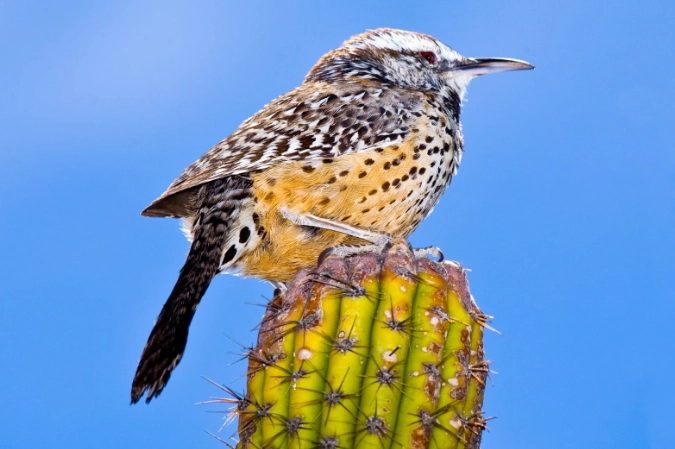
| Feature | Description | Why It Matters |
|---|---|---|
| Size & Shape | 7-9 inches long. Bulky, with a long tail often held upright. Large for a wren. | Its size helps it dominate its territory and handle larger prey. |
| Primary Colors | Speckled brown, white, and black. White eyebrow stripe is key. | The speckling provides excellent camouflage against desert rock and soil. |
| Bill | Long, stout, and slightly downcurved. Black. | Perfect for probing into cactus flowers, crevices, and under bark for insects. |
| Distinctive Markings | Heavy black spotting on chest/upper belly. Brown cap with white eyebrow. | These are the surefire field marks. The spotting is unique among U.S. wrens. |
Juveniles look similar to adults but are generally paler and have less distinct spotting. They'll get their full "adult suit" after their first molt.
Home Sweet (Spiky) Home: Cactus Wren Habitat
This is where the "cactus" part of its name earns its keep. The cactus wren is an obligate of desert scrublands. It's not just found there; it's utterly dependent on that environment, specifically on plants like cholla, saguaro, and prickly pear cactus.
Their range map is basically a drawing of the hot, dry parts of the southwestern U.S. and north-central Mexico. Think southern California, southern Nevada, Arizona, New Mexico, western Texas, and down into the Mexican states of Sonora and Baja California.
They need areas with dense, thorny vegetation. Why? Two main reasons: protection and nesting sites. Those intimidating spines are a fantastic deterrent to predators like snakes, roadrunners, and larger birds. For the cactus wren, they're just part of the furniture. I've seen them clamber through cholla joints that look like medieval torture devices without a second thought.
They're not strictly limited to pure, untouched desert either. You can find them in suburban areas on the edge of the desert, especially if there are native landscaping plants, large ornamental cacti, or thick, thorny hedges. They're adaptable as long as the core need for spiky cover is met.
I once saw a pair successfully nesting in a very large, very thorny pyracantha bush in a Tucson backyard. The homeowners had no idea they had such charismatic tenants until the young started making a racket. It goes to show that if you build it (a spiky habitat), they will come.
The Master Builder: Inside the Cactus Wren Nest
Okay, this is the coolest part. The cactus wren's nest is legendary, and for good reason. It's not a nest; it's a fortress, a multi-chambered condo complex made of grass and twigs.
It's a large, bulky, oval-shaped structure, often looking like a messy ball of debris stuck in a cactus or a thorny bush. They almost always build it within the protective embrace of a spiky plant, most famously the cholla cactus. The entrance is a small, tubular opening on the side.
Here's the wild thing: it's not just for raising babies. Cactus wrens build nests for sleeping in year-round. A single bird or a pair will maintain multiple nests within their territory. One is the primary nest for breeding, and the others are used as "roosting nests" or dormitories. Talk about real estate investment!
Why do they build such elaborate nests? The desert is a place of extremes—blazing hot days and surprisingly cold nights. That thick, woven-grass dome provides crucial insulation. It keeps the chicks (and the adults at night) warm when it's cold and shaded when the sun is brutal. The spiky location is, of course, the primary defense.
The construction is a joint effort. Both the male and female cactus wren gather materials—dry grasses, twigs, feathers, bits of fluff, even scraps of paper or string. They weave it all together into this incredible, durable structure. I have to admit, the first time I saw one of these massive nests, I thought it was an abandoned rodent pile! But up close, you can see the careful, purposeful weaving.
Pro Tip for Birders: If you see a large, obvious, football-sized mass of grass in a cholla cactus in the Southwest, you've almost certainly found a cactus wren nest. Give it a wide berth and watch from a distance. The parents are likely nearby and stressed by close observers.
A Day in the Life: Cactus Wren Behavior and Diet
These birds are diurnal, meaning they're active during the day. They're not big on soaring or graceful flight. Their movement is more characterized by hopping, climbing, and flitting from bush to bush. They spend their days foraging, constantly on the move.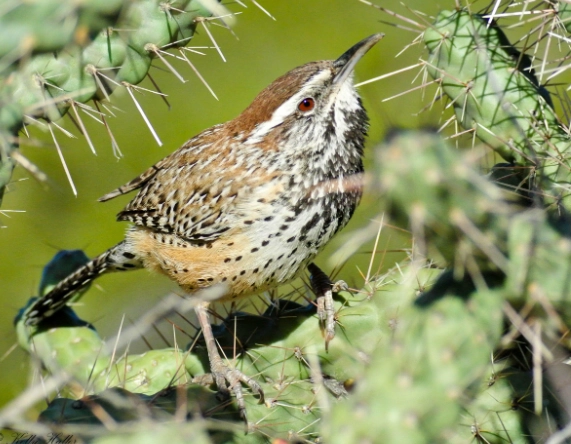
Their diet is what you'd expect from a desert insectivore, but it's surprisingly broad. They're opportunistic. The main menu includes:
Insects: This is the staple. Beetles, ants, grasshoppers, caterpillars, wasps, you name it. They'll flip over leaves and small rocks, probe into cracks in bark, and rummage through leaf litter on the ground. That curved bill is a perfect tool for extraction.
Spiders and other arthropods: A good source of protein.
Small fruits and berries: When available, they'll eat the fruit of cactus (like prickly pear tunas), desert mistletoe berries, and other native plants. This gives them moisture and sugars.
Seeds: They'll occasionally eat small seeds.
Even small vertebrates: There are documented cases of cactus wrens eating small lizards or tree frogs. They're not picky when an opportunity arises.
They don't typically visit standard bird feeders for seed, but their adaptability is key.
Their foraging style is fun to watch. It's a mix of determination and comic clumsiness. They'll hang upside down to inspect a leaf, hop along the ground with their tail held high, and make short, low flights between patches of cover. They're always busy.
The Sound of the Desert: Cactus Wren Calls and Songs
If the nest is their architectural masterpiece, their voice is their... well, it's loud. It's not the melodious song of a meadowlark. The cactus wren's vocalizations are harsh, grating, and mechanical. But in the quiet of the desert, it's a vibrant and essential sound.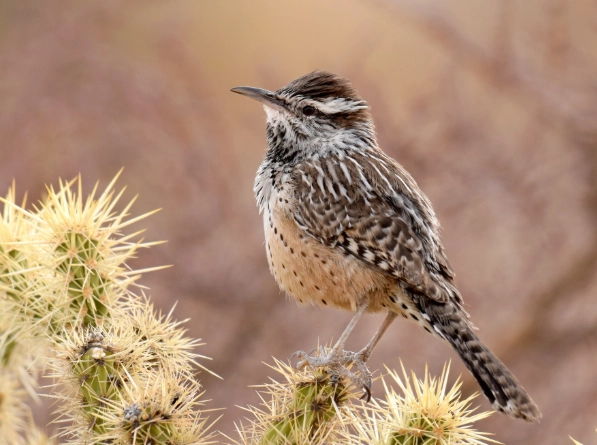
The most common call is a harsh, monotonous char-char-char-char or jar-jar-jar. It's often described as the sound of a car that won't start. This is used as an alarm call, a contact call between mates, and a general declaration of "I am here."
Their actual song is a slightly more varied series of these rough notes, sometimes accelerating into a chatter. It's not what you'd call beautiful, but it's full of character. You can hear examples of the cactus wren's distinctive voice on the Cornell Lab of Ornithology's All About Birds page, which is an fantastic resource for bird sounds.
They sing year-round, not just during breeding season, often from a high perch like the top of a cactus or a utility pole. It's how they defend their territory, which they do fiercely. A pair of cactus wrens might maintain a territory of 5 to 10 acres or more.
Family Life: From Eggs to Fledglings
Cactus wrens can have a remarkably long breeding season, sometimes from late winter through early summer, and they may raise more than one brood per year if conditions are good (like after a rainy season when insects are plentiful).
The female lays 3 to 5 eggs (sometimes more) in the specially built breeding nest. The eggs are a pale pinkish-buff color, heavily dotted with brown speckles. She does most of the incubation, which lasts about 16 days. The male feeds her while she's on the nest.
Once the chicks hatch, both parents are in constant motion feeding them. The nestlings are altricial—born naked, blind, and completely helpless. They grow incredibly fast on a diet of regurgitated insects. In just another 19 to 23 days, they're ready to leave the nest.
But here's a neat twist: the young often don't go far. The family group might stick together for a while, and the young from a first brood have even been observed helping their parents feed chicks from a second brood. That's pretty advanced social behavior for a wren.
The young birds are vulnerable after fledging, so they stick close to dense, thorny cover. Their parents continue to feed and protect them for several weeks as they learn to forage on their own.
Cactus Wrens and People: Backyard Friends?
Can you attract a cactus wren? It's possible, but you have to think like a desert bird.
First, you need to be within their natural range. No amount of effort in Maine is going to bring one to your yard. If you are in the Southwest, here's what you can do:
1. Plant native, thorny vegetation. This is the number one, non-negotiable requirement. Plant cholla, prickly pear, agave, or native thorny shrubs like desert hackberry or wolfberry. You're providing the essential cover and potential nest sites. Skip the perfectly manicured, spine-free landscaping if you want wildlife.
2. Provide water. A reliable, shallow bird bath or a drip fountain is a huge draw in the arid desert. Just make sure to clean it regularly.
3. Offer the right food. They're not big on seed feeders. Instead, consider offering mealworms (live or dried) in a shallow dish or platform feeder. Suet cakes, especially those with insects or fruit, can also be attractive. I'm not a huge fan of offering bread or processed foods to any wild bird; it's just not good for them.
4. Leave some "mess." A pile of fallen branches or leaves can provide foraging habitat for insects, which in turn attracts the birds that eat them.
The reward? You get a hilarious, bold, and fascinating bird that becomes part of your daily life. They have personality. They'll scold your cat, investigate your gardening tools, and provide endless entertainment with their antics.
Are They in Trouble? Conservation Status
This is a mixed bag. The cactus wren is still a common bird within its range, and its global population is considered stable by the International Union for Conservation of Nature (IUCN), which lists it as "Least Concern." However, that's the big picture.
On a local level, especially in coastal southern California, some subspecies are in serious trouble. The coastal cactus wren populations have been hammered by habitat loss due to urban development, agriculture, and wildfires. These birds are sedentary—they don't migrate—so when their patch of coastal sage scrub is paved over, they can't just fly to the next county. They disappear.
Wildfires are a particular threat. While the birds can sometimes survive a fire by fleeing, their nests (full of dry grass) are incinerated, and the slow-growing cacti they depend on can take decades to recover. In these areas, they are listed as a species of conservation concern.
The lesson here is that even a bird that seems tough and adaptable has its limits. Protecting large, connected tracts of native desert and scrubland is crucial for their long-term survival. Organizations like the National Audubon Society are deeply involved in conservation efforts for birds like the cactus wren and their habitats.
Your Cactus Wren Questions, Answered
Final Thoughts: Why This Bird Matters
The cactus wren is more than just a bird. It's an indicator species. Its presence tells you that a patch of desert or scrubland is healthy, with intact native vegetation and a functioning insect population. Its absence, especially where it should be, is a red flag.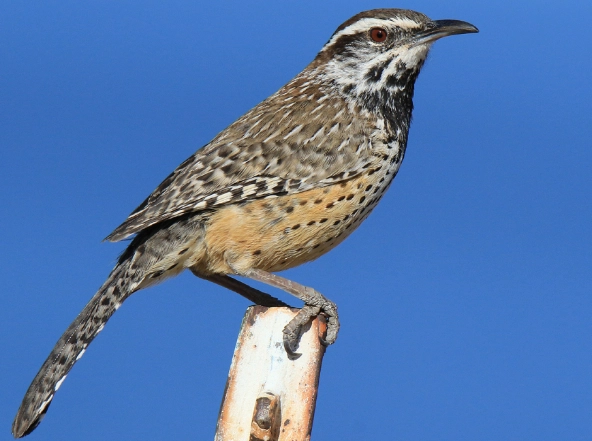
For me, it represents the spirit of the Southwest—resilient, a bit rough around the edges, full of surprises, and beautifully adapted to a place that seems inhospitable. Watching a cactus wren go about its business is a lesson in toughness and ingenuity.
Next time you're in the Sonoran or Chihuahuan Desert, stop and listen. That loud, grating chatter isn't just noise. It's the sound of a master survivor, a feathered architect, and one of the desert's most charismatic residents saying hello. Or maybe telling you to get off its lawn.
Hopefully, this guide answered your questions. From its spiky home to its fortress-like nest, the cactus wren is a bird that's hard to forget once you've met it.
Reader Comments