Your Birding Quick Guide
- The One Feature That Never Lies: The Bill
- Size and Presence: It's More Than Just Measurements
- Those Pesky Outer Tail Feathers: The Spot Check
- Voice and Behavior: The Sound and the Fury (of Pecking)
- Habitat and Range: Where to Expect Which
- Side-by-Side Comparison: The Quick-Reference Table
- Your Personal Field Strategy: A Step-by-Step Mindset
- Common Questions and Sticky Situations
- Why Bother? The Joy of Getting It Right
Alright, let's talk about a classic case of "birding déjà vu." You're out in the yard or on a trail, you hear that familiar tap-tap-tap, and you spot a neat little black-and-white woodpecker working on a tree. Your brain immediately goes, "Is that a Downy or a Hairy?" It happens to everyone, from total newbies to folks who've been at this for years. I've been there more times than I care to admit, especially in bad light or when the bird just won't turn its head.
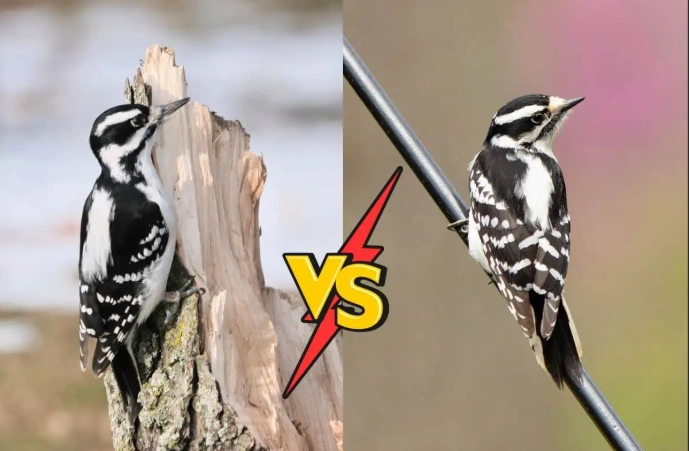
These two are like the identical twins of the woodpecker world in North America. At a glance, the pattern is basically a carbon copy: black wings with white spots, a white stripe down the back, that bold black line through the eye, and the males of both even sport that same red patch on the back of the head. No wonder it's confusing.
But here's the thing – once you know what to look for, telling them apart becomes almost easy. It's not about memorizing a textbook description. It's about training your eye to see a few, very reliable clues. This isn't just trivia; getting it right feels good. It adds a layer of depth to your time outdoors. So, let's settle the "What is the difference between a Downy and Hairy Woodpecker?" question once and for all, in plain English.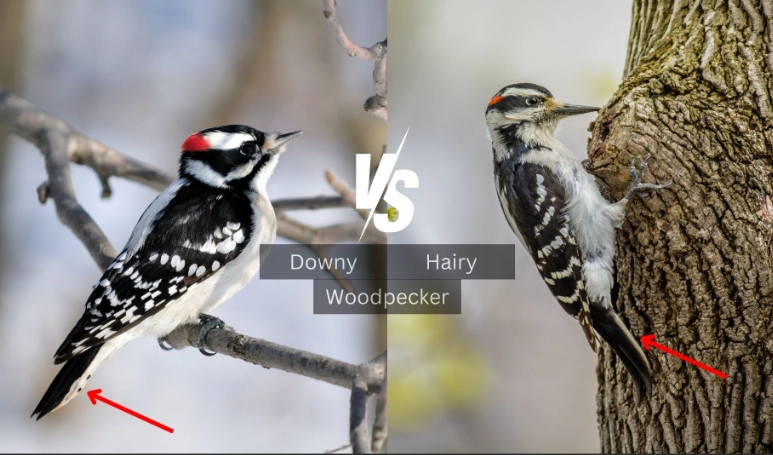
The One Feature That Never Lies: The Bill
If you remember nothing else from this article, remember the bill. This is the single most reliable difference, and it's obvious once you see it.
Think of the Downy Woodpecker's bill. It's small, delicate, and dainty – almost like a tiny sewing needle or a thorn. It looks like a tool for picking at tiny insects in weed stalks and small branches. Crucially, its length is shorter than the distance from the front of its eye to the back of its head. The bill seems like an afterthought on its face.
Now, the Hairy Woodpecker's bill is a whole different story. It's a robust, chisel-like tool. It looks substantial, powerful, and built for serious business – like excavating into solid wood for beetle larvae. Its length is about as long as, or even longer than, the entire length of its head from the front of the eye to the back of the skull. It's a prominent, unmistakable feature.
I was once with a friend who was new to birding. We saw one of these woodpeckers. She said, "Wow, its beak looks really strong." Bingo. That immediate impression of a "strong" or "big" beak almost always means Hairy. The Downy's bill just doesn't give that impression at all.
Size and Presence: It's More Than Just Measurements
Everyone says the Hairy is bigger. That's true on paper – the Hairy is about 9-10 inches long, while the Downy is a petite 6-7 inches. But in the field, without them side-by-side, how do you *feel* the size difference?
It's about the bird's overall presence. A Downy Woodpecker has a gentle, almost hesitant vibe. It's sparrow-sized. It flits quickly and often clings to the tiniest of twigs, even weed stalks like goldenrod. It looks right at home there.
A Hairy Woodpecker feels more substantial. It's robin-sized. Its movements seem more deliberate, stronger. You'll rarely, if ever, see one clinging to a flimsy weed stem. It's a bird of tree trunks and major limbs. Its pecking has a heavier, more resonant *thunk* compared to the Downy's lighter tapping.
So don't just think "bigger." Think: Is this bird dainty and sparrow-like, or robust and robin-like? That gut feeling, combined with the bill, gets you most of the way there.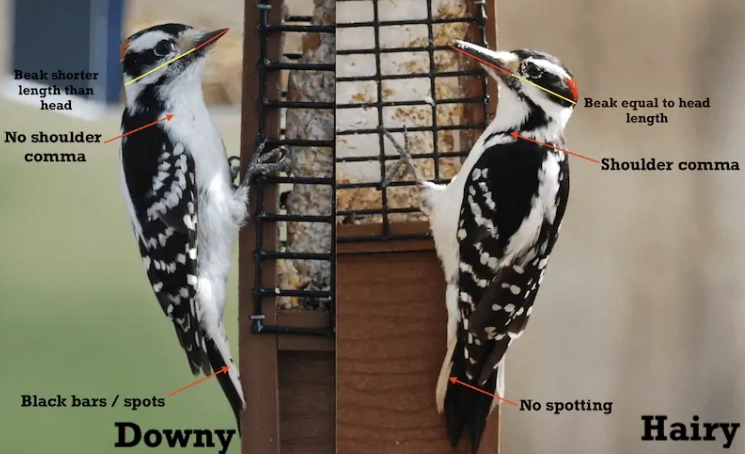
Those Pesky Outer Tail Feathers: The Spot Check
This is a classic field mark, but I'll be honest – it can be tricky. You need a clear view of the tail, and the lighting has to be decent. But when you see it, it's a fantastic confirmatory clue.
Both birds have mostly white outer tail feathers. The difference is in the black markings.
- Downy Woodpecker: Its outer tail feathers are almost entirely white, but they are usually peppered with a few small, discrete black spots or bars. Sometimes these spots are faint, but they're often there if you look closely.
- Hairy Woodpecker: Its outer tail feathers are typically pure, clean white without any black spots. They look immaculate.
I find this feature most useful in good photos or when the bird is perched sideways with its tail fanned. Trying to see tiny black spots on a twitching tail in poor light? Forget it. Rely on bill and size first, then use the tail to confirm your hunch if you get the chance.
Voice and Behavior: The Sound and the Fury (of Pecking)
You don't always see them first. Sometimes you hear them. Their calls are another great separator, and they fit their personalities perfectly.
The Downy's call is a soft, high-pitched, descending whinny: "pik-ik-ik-ik-ik-ik" that trails off. It also has a short, sharp "pik" note. Both sounds are relatively quiet and gentle, matching its diminutive size.
The Hairy's call is louder, sharper, and more forceful. Its typical call is a piercing, sharp "PEEK!" or a rapid, rattling series: "PEEK-PEEK-PEEK-PEEK." There's no gentle whinny. It sounds like a bigger, more assertive bird because it is.
Behaviorally, watch what they're pecking at. Downies are the acrobats of small branches. They'll hang upside down on twigs to get at insect eggs and galls. Hairys are the carpenters. They work on larger trunks and branches, often making significant excavations. If you see a woodpecker diligently working on a thick, dead tree limb, odds start tilting toward Hairy.
Habitat and Range: Where to Expect Which
This isn't a hard-and-fast rule, as both can overlap, but their preferences can set your expectations.
Downy Woodpeckers are the ultimate adapters. You'll find them in deciduous woodlands, orchards, city parks, and suburban backyards with just a few trees. They're frequent visitors to suet feeders, often becoming quite tame. Their small size allows them to thrive in fragmented habitats.
Hairy Woodpeckers tend to prefer larger, more mature tracts of forest. They are more common in extensive woodlands, both deciduous and coniferous. While they also visit feeders (especially for suet), they are generally shyer and less common in densely populated suburbs than Downies. If you're deep in a big forest and see a small black-and-white woodpecker, you should be thinking Hairy first.
That said, I've seen Hairys in parks and Downies in deep woods. Habitat is a clue, not a guarantee. Don't ID a bird solely based on where you are, but let it inform your initial guess.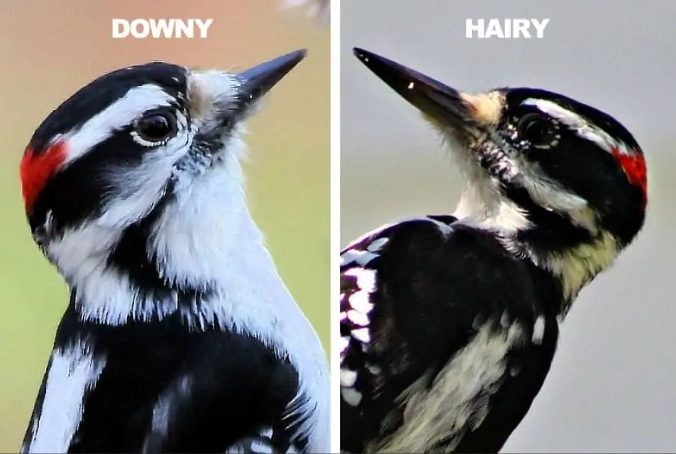
Side-by-Side Comparison: The Quick-Reference Table
Sometimes, you just need to see it all in one place. Here's a breakdown of the key differences we've discussed.
| Feature | Downy Woodpecker | Hairy Woodpecker |
|---|---|---|
| Size | ~6-7" (Sparrow-sized) | ~9-10" (Robin-sized) |
| Bill | Short, delicate, thorn-like. Shorter than head width. | Long, robust, chisel-like. As long as or longer than head. |
| Outer Tail Feathers | Usually have small black spots or bars. | Usually pure white, unmarked. |
| Typical Call | Soft, descending whinny ("pik-ik-ik-ik") or a sharp "pik". | Loud, sharp "PEEK!" or a rapid series. |
| General Vibe/Behavior | Dainty, acrobatic. Often on small branches & weed stalks. | Substantial, powerful. Prefers tree trunks & large limbs. |
| Habitat Preference | Highly adaptable: woodlands, parks, suburbs, backyards. | Prefers larger, more mature forests. Shyer at feeders. |
Your Personal Field Strategy: A Step-by-Step Mindset
Okay, theory is great. But what do you actually *do* when you see one? Don't panic and try to check every box at once. Follow this mental flow.
- First Impression: Big and robust, or small and dainty? Robin or sparrow?
- Zero In on the Face: Find that bill. Is it a tiny spike or a major chisel? This is your #1 priority. Spend your first few seconds here.
- Listen: What's it saying? A loud "PEEK" is a giant arrow pointing to Hairy.
- Context: What's it hammering on? A big trunk or a tiny twig?
- Bonus Check: If you get a great view of the fanned tail, look for spots.
If the bill looks small and the bird seems tiny, it's almost certainly a Downy. If the bill looks obviously long and sturdy on a bigger bird, it's a Hairy. It really can be that straightforward.
Common Questions and Sticky Situations
What about the juveniles?
Young birds of both species can look a bit scruffier, and the red mark on males is absent or different (sometimes a reddish wash on the forehead). But guess what? The bill doesn't lie. A juvenile Hairy still has that long, sturdy bill. A juvenile Downy's bill is still short. The size difference is also present from the get-go. So, your primary clues remain rock-solid.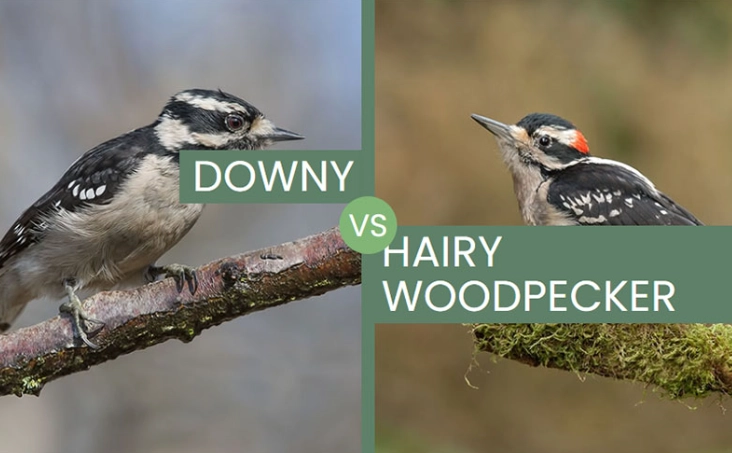
Are there regional variations?
Yes, but they're subtle and shouldn't throw you off the main features. For example, Hairy Woodpeckers in the Pacific Northwest can be darker-backed, and Downies in the West might have less white spotting on the wings. But the bill-size relationship, the tail spots (or lack thereof), and the vocalizations remain consistent across the continent. The core answer to what is the difference between a Downy and Hairy Woodpecker is universal.
Which one is more common at my feeder?
Statistically, the Downy Woodpecker is far more common at backyard feeders across most of its range. They are less shy and more numerous in suburban areas. Seeing a Hairy at your feeder is a treat—it's like the Downy's bigger, more reserved cousin who doesn't visit as often. If you have a steady visitor on your suet cake, it's probably a Downy.
Can I use field guides and apps to help?
Absolutely, and you should! But use them as learning tools, not crutches. After you see a bird, pull out the guide or your phone and compare. Look at the bill illustrations in a trusted source like the Cornell Lab of Ornithology's All About Birds site. Listen to the sound recordings on their pages for the Downy and the Hairy. This reinforces what you just saw and heard. Apps like Merlin Bird ID are fantastic, but try to make your own guess based on the features above before you tap the button.
Why Bother? The Joy of Getting It Right
 You might ask, why go through all this trouble for two birds that look so similar? For me, it's about moving from just "seeing birds" to truly observing them. It deepens your connection to the natural world right outside your window. It turns a casual glance into a mini-discovery.
Every time you correctly identify a Downy or a Hairy, you're not just naming a bird. You're practicing the fundamental skill of birding: paying close attention to detail. You're learning to see size, shape, structure, and behavior. These skills will translate to identifying hawks, sparrows, warblers—everything.
So, the next time you hear that tapping, don't just shrug and say "woodpecker." Take a breath, look for that bill, gauge its size, and listen. You've got the tools now. The difference between a Downy and Hairy Woodpecker isn't a mystery anymore—it's a fun puzzle you're equipped to solve. Happy birding!
Reader Comments