In This Guide
You're filling your bird feeder, enjoying the morning chorus of chickadees and finches, when suddenly—a gray-blue blur. A silent explosion of feathers. The songbirds scatter in panic, and just like that, the feeder is empty. If you've witnessed this heart-pounding scene, you might have just had a close encounter with one of North America's most fascinating and misunderstood predators: the Sharp-Shinned Hawk.
Let's be honest, for most people, a hawk is just a hawk. But for birders and anyone with a backyard feeder, learning to tell them apart becomes a bit of an obsession. And the sharp shinned hawk sits right at the center of that puzzle. It's the smallest accipiter on the continent, a bird built for one thing: hunting other birds with terrifying precision in dense woodland. I remember the first time I positively identified one. I'd spent weeks confusing it with its larger cousin, the Cooper's Hawk. The moment it clicked—seeing that squared-off tail, those ridiculously skinny legs—felt like solving a mystery.
This guide is for anyone who's ever squinted at a hawk and wondered, "Is that a Sharpie?" We're going to move beyond the textbook descriptions and get into the real, sometimes messy, details of this bird's life. We'll cover everything from the subtle tricks to tell it apart from the Cooper's Hawk (a challenge that still trips me up sometimes) to its secretive nesting habits and its crucial role in the ecosystem. Forget dry, scientific lists. Think of this as a conversation from one curious observer to another.
What Exactly Is a Sharp-Shinned Hawk?
Before we dive into the nitty-gritty, let's set the stage. The Sharp-Shinned Hawk (Accipiter striatus) is a true bird hawk, or accipiter. This family is built for maneuverability—short, rounded wings and long tails for zipping through forests after agile prey. While the more common Red-tailed Hawk soars over open fields looking for rodents, the Sharpie is a forest stalker. Its world is one of branches, shadows, and sudden, violent bursts of speed.
The name "sharp-shinned" comes from the keel, or sharp front edge, of its long lower leg bone (the tarsus). It's a subtle feature, but it hints at the bird's predatory design. They are widespread across North America, breeding in the vast boreal forests of Canada and the northern US and wintering throughout the lower 48 states, Mexico, and Central America. So whether you're in Maine or California, there's a chance you might spot one, especially during migration when they're funneling along coastlines and mountain ridges.
The Art of Identification: Spotting a Sharpie
Okay, this is the part everyone struggles with. Identifying a sharp shinned hawk, especially from its doppelgänger the Cooper's Hawk, requires looking at a combination of features. Relying on just one can lead you astray. Here’s a breakdown of what to look for.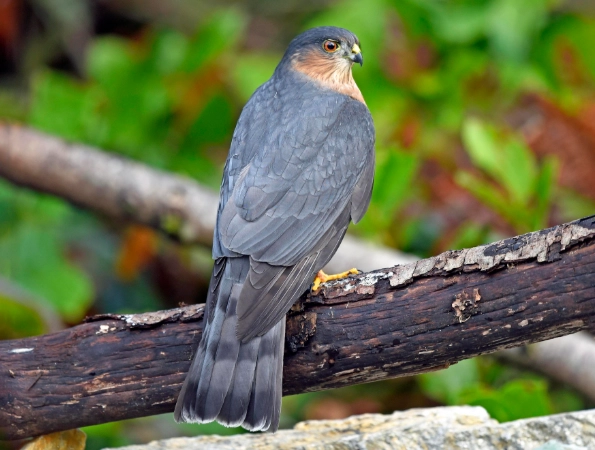
Size and Shape: The Overall Impression
First, size is a terrible field mark on its own. A female Sharp-Shinned Hawk is nearly as big as a male Cooper's Hawk. You need shape. The classic Sharpie shape is like a "flying cross." Its head appears small and barely projects beyond the leading edge of its wings in flight. The tail is long and often looks square or slightly notched at the tip, not rounded. The wings are short, broad, and pushed forward, giving it a frantic, quick-flapping flight style. When perched, it often looks upright and narrow-chested.
I've found that the gestalt—the overall feeling—is often the first clue. Something looks... compact and hyper.
Key Field Marks: From Head to Tail
Let's get specific. Here are the markers you should be piecing together:
- The Head: The head looks small, like it's been shoved into the shoulders. The crown is dark, and adults have a dark hood that contrasts with a paler nape. The eyes on an adult are deep red, which can be startling to see up close. Juveniles have yellow eyes.
- The Tail: This is a big one. The tail feathers (rectrices) are all about the same length, creating that squared-off or very slightly notched tip. Look closely at the tip from the back—if it looks even, think Sharpie. The tail also has distinct, dark bands.
- Underparts: Adults have fine, horizontal rufous barring on the breast and belly. Juveniles have thick, dark brown streaks that often look blotchy or teardrop-shaped. The white undertail coverts (the fluffy feathers under the base of the tail) are often prominent and puffy.
- Legs and Feet: They have comically skinny, pencil-like yellow legs. This is often cited as a key mark, and when you see it, it's very helpful. Their toes are long and spindly.
The Flight Pattern: How It Moves
You'll often see a Sharpie in flight before you see it perched. Their flight is diagnostic. It's a rapid series of quick, snappy wingbeats—flap-flap-flap-glide—followed by a short glide. It looks energetic and somewhat erratic. When soaring (which is less common), the wings are held straight out, and the head barely projects. In contrast, a Cooper's Hawk has slower, more powerful wingbeats and a longer glide.
During migration, they avoid crossing large bodies of water, so look for them at hawk watches along coastlines, river valleys, and mountain passes. Seeing dozens streaming by on an autumn day is an incredible sight.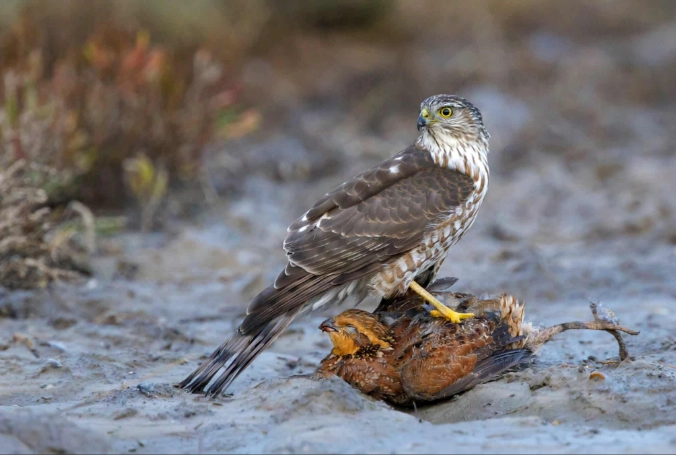
| Feature | Sharp-Shinned Hawk | Cooper's Hawk |
|---|---|---|
| Head Size | Small, appears "sunken" into shoulders | Larger, projects noticeably forward |
| Tail Shape | Square or slightly notched tip | Rounded tip (outer feathers shorter) |
| Neck | Very short, often not visible | Longer, more distinct |
| Eye Placement | Centered in the head | Closer to the bill, giving a "meaner" look |
| Leg Thickness | Extremely thin, pencil-like | Substantially thicker |
| Flight Style | Rapid, snappy wingbeats; jerky | Slower, stiffer, more powerful flaps |
| Typical Prey Size | Small birds (sparrows, warblers) | Medium birds (jays, doves, pigeons) |
A Life in the Shadows: Behavior and Ecology
Understanding what a sharp shinned hawk does helps you understand what it is. This isn't a majestic, soaring eagle. It's a secretive, often solitary hunter of the understory.
The Hunting Strategy of an Avian Ambush Predator
Sharp-Shinned Hawks are masters of surprise. They typically hunt from a concealed perch, launching a blistering, low-altitude attack. They use vegetation as cover, weaving through branches with astonishing agility to get within striking distance of unsuspecting songbirds. They pluck their prey before eating, often at a favorite "plucking post"—a stump or low branch littered with feathers. Their diet is almost exclusively small birds, from warblers and sparrows to the occasional woodpecker or dove. Insects and small mammals make up a tiny fraction of their meals.
This specialization is why they're so commonly seen near bird feeders. A feeder is a predictable, concentrated buffet. While it can be distressing to see, it's a completely natural event. The sharp shinned hawk isn't being "mean"; it's just being a hawk, fulfilling its ecological role.
Nesting and Family Life: The Secretive Parent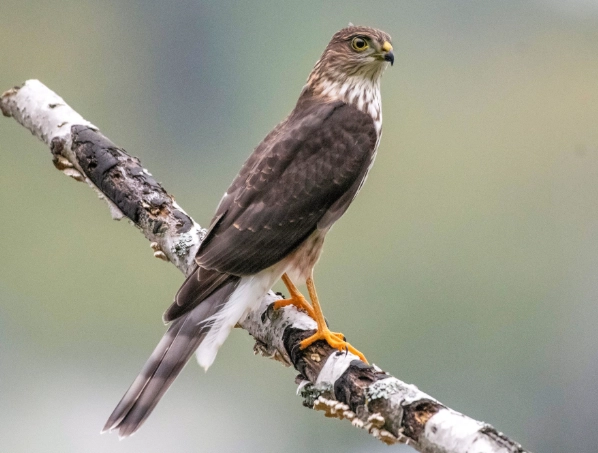
Finding a Sharp-Shinned Hawk nest is a real achievement. They nest in dense coniferous or mixed forests, often choosing a site near the trunk of a tree, close to the canopy. The nest itself is a flimsy-looking platform of twigs, surprisingly small for the bird. The female does most of the incubating of the 3-8 eggs, which are a beautiful pale blue, often blotched with brown.
The young hatch after about a month and are voracious. Both parents hunt tirelessly to feed them. Watching the fledglings learn to hunt is a lesson in persistence—they are clumsy and unsuccessful at first, slowly honing the skills that make adult sharp shinned hawks so effective. The family stays together for several weeks after the young leave the nest before dispersing.
The Sharpie's Role in the Ecosystem (And Why It Matters)
It's easy to see a predator at a bird feeder as a villain. But the Sharp-Shinned Hawk plays a critical, non-negotiable role. As a top predator of small birds, it helps regulate songbird populations, often culling the sick, weak, or slow. This natural selection pressure can actually strengthen prey populations over time. They are a key indicator of forest health; healthy, complex forests support healthy Sharp-Shinned Hawk populations.
Their presence signifies a functioning, balanced ecosystem. Removing predators like the Sharpie leads to unforeseen consequences, like overpopulation of certain prey species. According to the American Bird Conservancy, maintaining healthy populations of native predators is a cornerstone of conservation.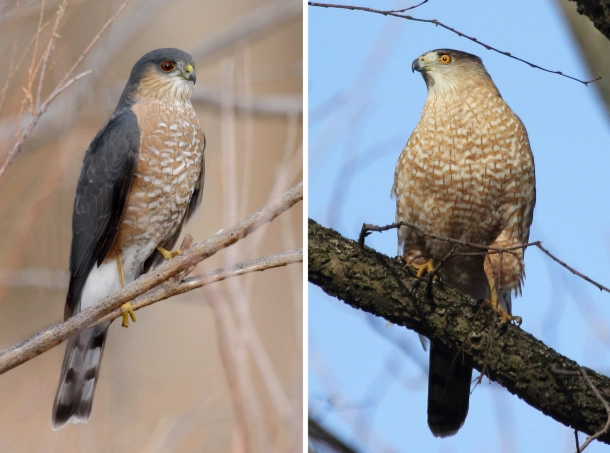
How to Ethically Observe and Photograph Sharp-Shinned Hawks
So you want to see one of these elusive hunters for yourself? Here's how to do it responsibly.
- Where to Look: In breeding season, focus on large tracts of mature forest. In winter and migration, check edges—forest edges, suburban woodlots, and yes, areas with bird feeders. Hawk watch sites during autumn migration (check data from places like the Hawk Mountain Sanctuary) are fantastic.
- Patience is Key: You'll likely hear the alarm calls of smaller birds first. A sudden, panicked silence can also be a sign.
- Photography Ethics: Never stress a bird for a photo. This is especially crucial near a nest. Use a long lens and keep your distance. The welfare of the bird always comes before the shot. The Cornell Lab of Ornithology's ethics guidelines are a great resource for any birder with a camera.
I carry a small notebook to jot down observations—lighting, behavior, what the bird was doing before it flew. These notes have helped me learn far more than any blurry, distant photo I've taken.
Frequently Asked Questions About Sharp-Shinned Hawks
Will a Sharp-Shinned Hawk Attack My Pet?
This is a huge concern, but generally, no. A Sharp-Shinned Hawk's prey maxes out at about the size of a Robin or Mourning Dove. A typical cat or small dog is far too large and dangerous for them to consider. They pose no threat to healthy adult pets. Very small toy breed puppies or kittens left unattended could theoretically be at risk, but this is exceedingly rare. The risk is vastly overstated online. Your pet is much more likely to be harmed by a car or another disease than by any hawk.
Are They Endangered?
Globally, no. The Sharp-Shinned Hawk is listed as a species of "Least Concern" by the IUCN. However, they face significant threats. Habitat loss is a major issue, as they require large, undisturbed forests for breeding. They are also highly vulnerable to collisions with windows and vehicles, and historically suffered from pesticide poisoning (like DDT) which thinned their eggshells. Conservation efforts focused on preserving large forest tracts and public education about window collisions (through organizations like the U.S. Fish and Wildlife Service) benefit them directly.
How Can I Tell a Juvenile Sharpie from a Juvenile Cooper's?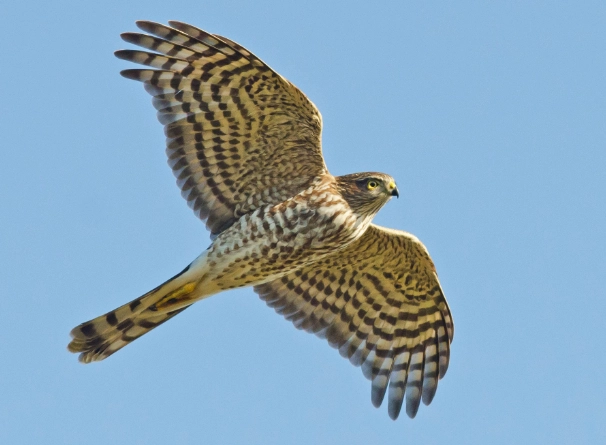
Oh, this is the advanced exam. Juveniles of both species are brown above with streaked underparts. You must fall back on structural features: head projection, tail shape, and leg thickness. The juvenile Cooper's will already have that more prominent head and thicker legs. The streaking on a juvenile Sharpie also tends to be heavier and messier, often covering the entire belly, while a juvenile Cooper's may have cleaner streaking restricted to the chest. It's hard. Don't feel bad if you can't call it.
Do They Migrate?
Yes, extensively. Populations that breed in Canada and the northern US migrate south for the winter, some traveling as far as Central America. This is why you're more likely to see one in your backyard in winter—the local population is supplemented by northern migrants. Their migration is diurnal (during the day), and they use thermals to assist their travel.
What's Their Lifespan?
Like most small raptors, they have a tough life. The mortality rate in the first year is very high, possibly over 70%. If they survive that first treacherous year, they can live for several years. The oldest known Sharp-Shinned Hawk, banded and recaptured, was over 12 years old. That's a veteran of countless hunts and migrations.
Wrapping this up, the Sharp-Shinned Hawk is more than just a bird that scatters your finches. It's a finely-tuned embodiment of forest adaptation, a crucial piece of the ecological puzzle, and a constant, humbling identification challenge for birders. Its presence, even when it's causing a momentary panic at the feeder, is a sign of a dynamic, living world right outside our windows. The next time you see that gray flash, take a moment. Look past the initial surprise. See the square tail, the intense gaze, the incredible design of a perfect forest hunter. You're not just seeing a hawk. You're seeing a Sharpie.
And if you still can't tell if it's a Sharp-Shinned Hawk or a Cooper's Hawk? Welcome to the club. We meet every time we look at a blurry photo and scratch our heads. The fun is in the trying.
Reader Comments