Let's cut right to the chase. You've probably heard the claim: the peregrine falcon is the fastest animal on Earth. It's one of those nature facts that gets thrown around a lot, right up there with the immortal jellyfish and the immortal... okay, maybe not that one. But here's the thing—it's absolutely true. And the real story behind that peregrine falcon speed is so much cooler and more complex than a simple number on a page.
I remember the first time I saw one in a stoop. It wasn't in some fancy documentary; it was from a cliffside path, watching a dark speck high above a valley just... disappear. One second it was there, the next it was a blurred streak aimed at the ground. My brain couldn't even process the movement. It was less like watching a bird fly and more like watching a bullet get fired. That moment stuck with me, and it's what got me digging into the how and why.
The Bottom Line Up Front: In a hunting dive called a stoop, a peregrine falcon can reach speeds exceeding 240 miles per hour (386 km/h). Verified scientific records, like those documented by the Cornell Lab of Ornithology, clock them at between 200-240 mph. Some observations suggest bursts even closer to 250 mph. This isn't just flying fast. This is falling with such insane, controlled purpose that it redefines what we think is possible in the animal kingdom.
In This Article
- So, How Fast Is It Really? Breaking Down the Numbers
- Built for Speed: The Falcon's Biological Blueprint
- Speed Comparison: How Does the Peregrine Falcon Stack Up?
- Why So Fast? The Evolutionary "Why" Behind the Speed
- Common Questions About Peregrine Falcon Speed (Answered)
- Beyond the Record: The Peregrine's Story of Survival
- Witnessing the Speed: Tips for Your Own Observations
- Final Thoughts: More Than Just a Number
So, How Fast Is It Really? Breaking Down the Numbers
Throwing out "240 mph" is one thing. Understanding what that means is another. Let's put that peregrine falcon speed into context, because honestly, our human brains aren't wired to understand velocities that high in the real world.
Think about driving on a highway. The legal limit is often 70 mph. Now imagine going more than three times that speed. At 240 mph, the falcon is covering the length of a football field in less than a single second. Let that sink in. One. Second.
But here's a crucial detail a lot of articles gloss over: the peregrine falcon doesn't cruise at this speed. You won't see it zipping along the horizon at 200 mph. That breathtaking velocity is reserved for a very specific, lethal maneuver. In level flight, they're impressive but not record-breaking—maybe 40-60 mph when they're really moving. The magic, and the world record, happens when they point their heads down and surrender to gravity.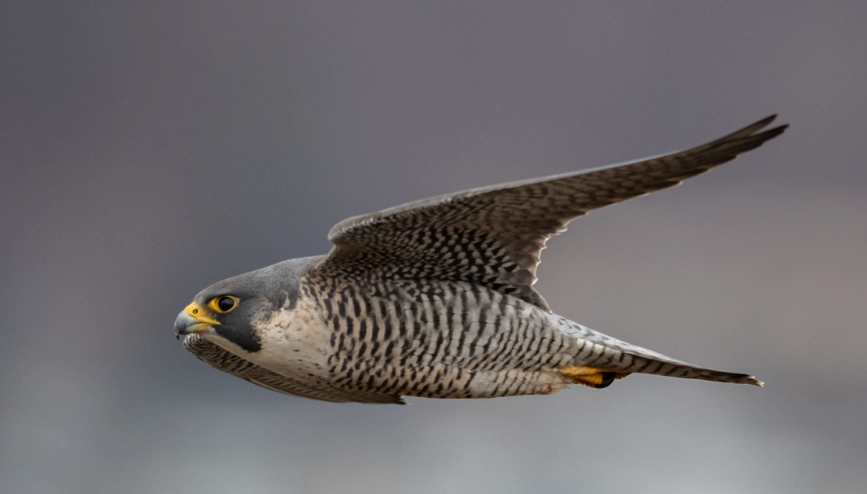
The Stoop: Anatomy of a High-Velocity Attack
The stoop is the peregrine's signature move. It's not a simple drop. It's a multi-stage aerial assault that is a masterclass in physics and biology.
- The Climb & Scan: It all starts high up. The falcon gains altitude, sometimes circling over a kilometer above the ground. From this "high ground," it uses its incredible vision (which we'll get to) to spot potential prey like pigeons, ducks, or shorebirds.
- The Tuck & Aim: Once a target is locked, the falcon ceases flapping. It turns its head down, pulls its wings tight and partially swept back against its body, and streamlines itself into a feathered bullet. This shape minimizes drag to an absurd degree.
- The Controlled Fall: Gravity takes over. The falcon isn't just falling; it's accelerating in a controlled dive. It uses slight adjustments of its wings, tail, and head to steer, keeping the prey perfectly in its sights. This is where the peregrine falcon speed skyrockets.
- The Strike: It doesn't grab the prey with its talons mid-dive at full speed—that would be catastrophic for its own legs. Instead, at the last possible moment, it levels out slightly or delivers a devastating, clenched-fist punch with its hind talon (the hallux). The impact alone is often enough to kill or stun the prey instantly. The force is so great it can literally knock the head off a smaller bird. Then, it simply swoops back up to catch the falling victim.
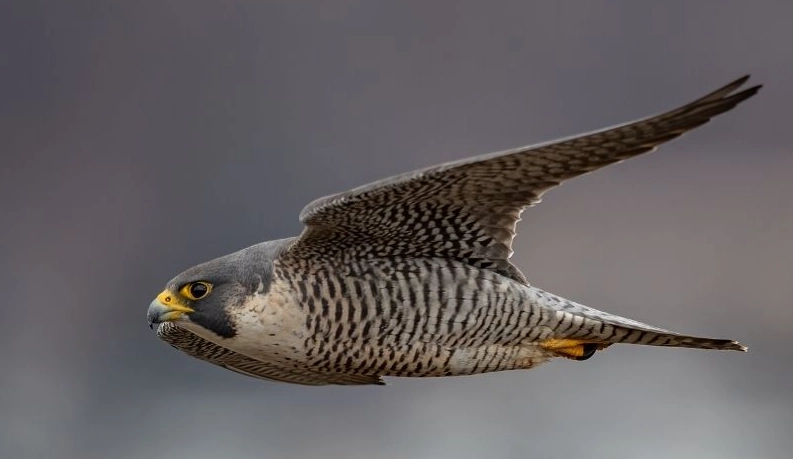
A Common Misconception: You'll sometimes see claims of peregrines breaking the sound barrier or hitting 300 mph. These are exaggerations or based on flawed early measurements. The current scientific consensus, backed by modern telemetry and radar studies, places the reliable top peregrine falcon dive speed firmly in the 200-240 mph range. Still utterly mind-blowing, but let's stick to the verified facts.
Built for Speed: The Falcon's Biological Blueprint
You don't accidentally become the fastest thing on the planet. Every part of a peregrine is engineered, by millions of years of evolution, for one thing: achieving and surviving insane velocity. It's not just one feature; it's the total package.
The Speed Toolkit: Key Adaptations
- The Nostril Baffle (Tubercle): This is my favorite bit. Inside their nostrils is a small, central cone or baffle. Its sole job? To slow down and regulate the rush of air entering their lungs during a high-speed stoop. Without it, they'd essentially hyperventilate or damage their respiratory system. It's a built-in air brake for their face!
- Super-Dense Feathers: Their feathers are stiffer and more tightly knit than most birds'. This creates a smooth, rigid surface that air flows over cleanly, reducing turbulence and drag. Think of the difference between a baggy tracksuit and a skin-tight racing suit.
- Ridiculously Powerful Heart & Lungs: To keep its muscles oxygenated during the intense exertion and G-forces of a stoop, the peregrine has a massive heart and super-efficient lungs. Its heart rate can skyrocket, and it can process oxygen at a rate that would leave other animals in the dust.
- The Keel: That prominent breastbone is the anchor for the huge flight muscles (the pectorals) that power the wings. It's like the chassis of a race car.
- Vision 2.0: A peregrine's eyes are enormous relative to its head. They have two foveae (central focusing points) in each eye, giving them incredible telescopic sight to spot prey from kilometers away. They also have a special third eyelid, the nictitating membrane, which acts like a pair of goggles to protect and clean their eyes during the dive.
When you stack all these adaptations together, you start to see why no other bird can compete. It's a perfect storm of biological engineering. The peregrine falcon's speed isn't an accident; it's the culmination of its entire physical being.
Speed Comparison: How Does the Peregrine Falcon Stack Up?
Okay, so it's fast. But is it *the* fastest? Let's look at the competition. This is where a table actually helps make sense of things.
| Animal | Top Speed (mph) | Top Speed (km/h) | Context / Method | Notes |
|---|---|---|---|---|
| Peregrine Falcon | 240+ | 386+ | Diving (Stoop) | Widely accepted as the fastest animal overall. Speed is achieved in a gravity-assisted dive. |
| Golden Eagle | 150-200 | 240-320 | Diving | Also uses a stoop, but its larger size and different build limit top speed compared to the sleeker falcon. |
| Cheetah | 60-75 | 97-120 | Running | Fastest land animal. Speed is explosive but lasts only 20-30 seconds. |
| Peregrine Falcon (Level Flight) | 40-60 | 64-97 | Flapping Flight | Highlights the critical difference between diving and cruising speed. |
| Spine-Tailed Swift | ~70 | ~112 | Level Flight | Often cited as the fastest bird in level, flapping flight. No dive required. |
| Brazilian Free-Tailed Bat | ~100 | ~160 | Level Flight | Recent studies suggest incredible horizontal speed, making it the fastest mammal in flight. |
| Fighter Jet (F-16) | 1,500+ | 2,400+ | Powered Flight | For pure, absurd scale. The falcon is nature's version of a precision missile. |
See the pattern? The peregrine is in a league of its own when you consider its specific niche: the high-speed aerial strike. The cheetah wins on land, the swift wins in horizontal flight, but for pure, unadulterated velocity in a single maneuver, nothing touches the peregrine falcon's stoop speed.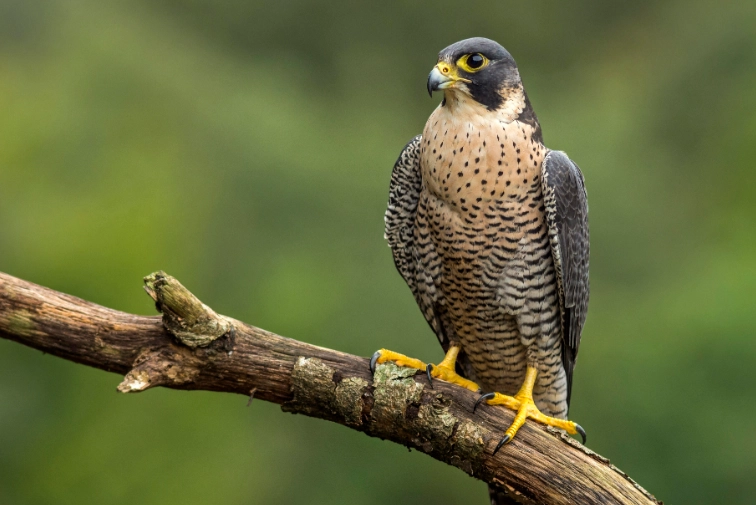
Why So Fast? The Evolutionary "Why" Behind the Speed
Evolution doesn't do things for fun. A trait this extreme exists because it solves a critical problem. For the peregrine, speed is its entire hunting strategy.
Its preferred prey—other birds—are themselves fast, agile, and have a huge advantage: they can see the attack coming. A pigeon can twist and turn in the air. So how do you catch something that can outmaneuver you? You remove its ability to react. You hit it with so much speed, from such a distance and angle, that by the time the prey's nervous system even registers the threat, it's already over.
The peregrine falcon's speed is the ultimate ambush weapon. It turns the vast, open sky into a kill zone. The prey's agility is meaningless against an attack that covers the final hundred meters in a fraction of a second. It's less about pursuit and more about overwhelming, precise force.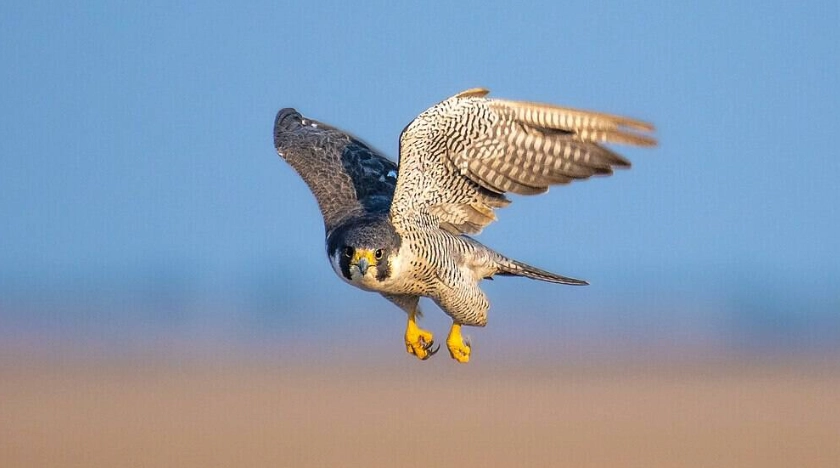
Factors That Affect Their Top Speed
Not every stoop hits 240 mph. Just like a race car driver needs the right conditions, so does the falcon. Its actual peregrine falcon dive speed in any given moment depends on a few things:
- Altitude: Higher starting point = longer dive = more time to accelerate = higher potential top speed. Simple physics.
- Prey Type & Behavior: A duck flying straight and level is a easier target for a max-speed strike than a twisting, diving swallow.
- Weather & Wind: A tailwind can add a significant boost. Conversely, diving through turbulent air is risky and inefficient.
- The Individual: Age, experience, and physical condition matter. A mature adult in its prime will outperform a juvenile.

Common Questions About Peregrine Falcon Speed (Answered)
Could a peregrine falcon's dive speed break the sound barrier?
Almost certainly not. The speed of sound at sea level is about 767 mph (1,235 km/h). Even with gravity's help, biological limitations—air density, structural integrity of bones and feathers, the ability to breathe—prevent a bird from reaching anything close to that. The 200-240 mph range is the biomechanical ceiling for this animal.
How do scientists even measure something that fast?
Early methods involved estimation from film or using stopwatches and known distances—pretty crude. Modern science uses sophisticated tools like Doppler radar (the same kind used for weather and baseball pitches) and high-resolution GPS telemetry tags fitted to the birds. Researchers at institutions like the Vermont Center for Ecostudies use these techniques to gather precise data on bird movements and speeds.
Has a peregrine falcon ever been recorded going faster than 240 mph?
There are anecdotal reports and older, less reliable studies that suggested speeds near 270 or even 280 mph. However, these haven't been consistently verified with modern equipment. The scientific community, including ornithological bodies like the American Ornithological Society, generally upholds the 200-240 mph (322-386 km/h) figure as the credible, documented range based on the best available evidence we have today.
Is the speed dangerous for the falcon itself? How does it not pass out or get hurt?
This is an excellent question. The G-forces involved in pulling out of a 200+ mph dive are immense. Their robust anatomy—strong bones, that specialized respiratory system, and a cardiovascular system built for stress—handles it. The real risk is misjudgment. Hitting a prey bird at the wrong angle or colliding with an object (like a window or wire) at that speed is fatal. It's a high-risk, high-reward strategy.
How does its speed compare to a fighter jet or race car?
In raw numbers, a modern jet is 5-6 times faster. But that's not a fair comparison. A jet requires massive engines and fuel. The falcon is a self-contained, biological system. A better analogy is a missile. The peregrine is nature's equivalent of a precision-guided missile: relatively short range, incredible terminal velocity, and a single, devastating purpose.
Beyond the Record: The Peregrine's Story of Survival
It feels wrong to talk about this bird's amazing abilities without mentioning its modern history. The peregrine falcon's speed couldn't save it from the pesticide DDT in the mid-20th century. DDT caused their eggshells to thin and break, leading to catastrophic population crashes across North America and Europe. They were literally wiped out in entire regions.
Their recovery is one of conservation's great success stories. Through banning DDT, captive breeding programs, and reintroduction efforts, they've made a stunning comeback. Seeing a peregrine now, even in major cities where they nest on skyscrapers and hunt pigeons, is a testament to that work. Organizations like the IUCN Red List now classify them as a species of "Least Concern," a status that would have seemed impossible 50 years ago.
This comeback adds another layer to their awe. We're not just observing a relic of a wild past. We're witnessing a resilient survivor that has reclaimed its place in the skies, from remote cliffs to urban canyons, still performing its incredible high-speed stoops against all odds.
Witnessing the Speed: Tips for Your Own Observations
If you want to have a chance of seeing this phenomenon yourself, you need to know where and when to look. They're more widespread than you might think.
- Habitat: Look for open areas near high perches. Coastal cliffs, river valleys, mountain ranges, and increasingly, large cities with tall buildings and bridges. Cities provide a perfect "cliff" substitute and an endless supply of pigeon prey.
- Season & Time: Early morning is often the best hunting time. In many areas, they are year-round residents, but spring and fall migrations can concentrate birds and activity.
- What to Look For: First, look for other birds panicking. A flock of pigeons suddenly scattering or diving for cover is a dead giveaway. Then, scan the skies high above them. The peregrine will often be a small, dark, cross-shaped speck circling. The stoop itself is a blur—a dark streak aimed at the ground or at another bird.
- Listen: Their call is a rapid, harsh series of "kak-kak-kak" sounds. Hearing this can alert you to their presence.
I'll be honest, seeing a full, top-speed stoop in the wild requires patience and a lot of luck. More often, you'll see a fast, powerful chase. But even that is impressive. And knowing what that bird is capable of makes the sighting infinitely cooler.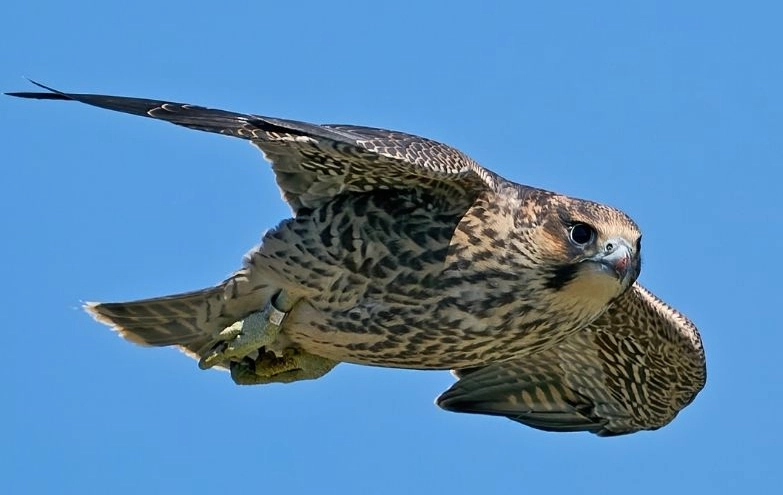
Final Thoughts: More Than Just a Number
At the end of the day, reducing the peregrine falcon to "the fastest animal" does it a disservice. The speed is the headline, but the story is in the biological engineering, the evolutionary arms race, the sheer audacity of its hunting strategy, and its remarkable recovery from the brink.
The peregrine falcon's speed isn't just a cool fact. It's a window into how extreme the pressures of survival can be, and how life can evolve solutions of breathtaking elegance and power. It reminds us that the natural world still holds performances of physics and skill that our best technology can only mimic in crude form.
So next time you hear that factoid, you'll know there's a whole world behind it. A world of specialized nostrils, G-force tolerance, aerial ambushes, and a bullet-shaped bird that, for a few seconds at a time, becomes the fastest living thing on Earth. Not bad for a creature that fits on your arm.
Reader Comments