快速导览
- The Build: Anatomy of an Apex Predator
- A Rainbow of Feathers: Plumage Variations and Morphs
- How They Move: Flight and Behavior Patterns
- The Voice: That Iconic Scream (and Other Sounds)
- Home and Habitat: Where to Find Them
- Diet and Hunting: What's on the Menu?
- Life Cycle and Reproduction
- Their Role in the Ecosystem and Conservation
- Final Thoughts: Putting It All Together
You've probably seen it a hundred times. Perched stoically on a highway light pole, circling high overhead on a thermal, or even featured as that iconic, piercing scream in every movie ever made (even when the bird on screen is clearly an eagle). The Red-tailed Hawk is arguably North America's most familiar and widespread raptor. But here's the thing – for a bird so common, there's a surprising amount of confusion about its actual characteristics. Is every brown hawk a Red-tail? What about the ones that aren't red? I remember spending years as a beginner birder getting frustrated, misidentifying everything from vultures to falcons as this ubiquitous Buteo. It's not as straightforward as the field guides sometimes make it seem.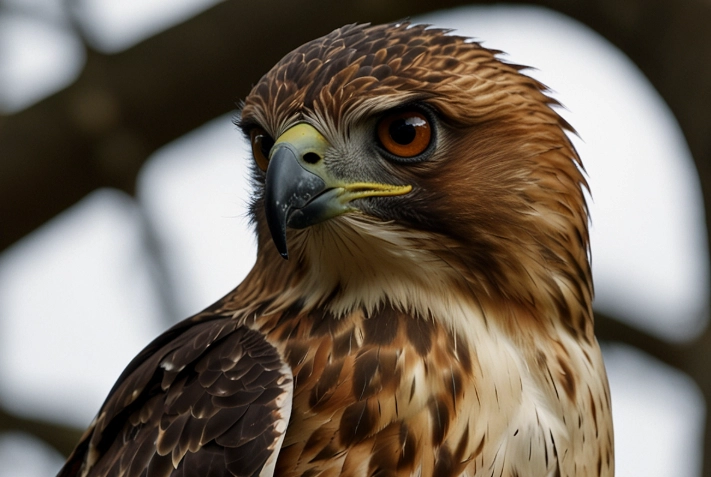
This guide aims to cut through the noise. We're going deep on Red-tailed Hawk characteristics, moving beyond the textbook basics into the messy, wonderful details that will let you identify them with confidence in any season, in any plumage. Forget just the tail – we're talking build, behavior, voice, and all the quirks that make a Red-tail a Red-tail.
The Build: Anatomy of an Apex Predator
Let's start with the overall impression. Red-tailed Hawks are what birders call "Buteos" – think broad, stocky bodies, wide, rounded wings, and relatively short, broad tails. They're built for power and soaring, not for the lightning-fast dashes of a falcon. When you see one perched, it just looks substantial. A bulky chest, a sort of "frowning" expression created by the brow ridge, and those powerful, yellow feet tipped with black talons.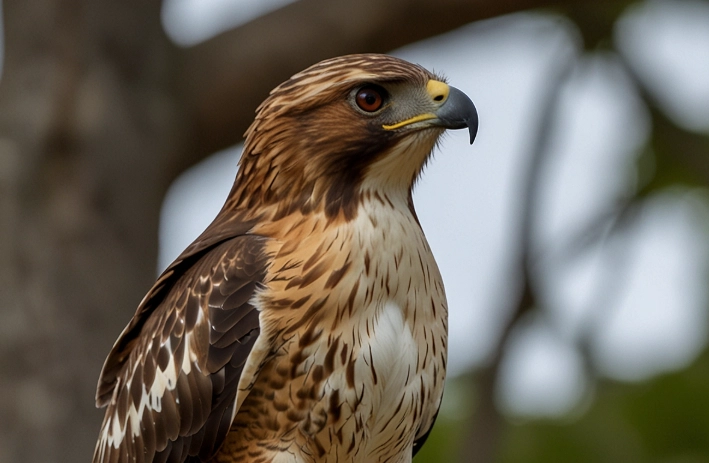
Size-wise, they're impressive. Females are larger than males, as is typical for raptors. Their wingspan stretches between 45 to 52 inches (that's over 4 feet), and they can weigh anywhere from 1.5 to 3.5 pounds. To put it in perspective, that's about the weight of a small house cat, but all muscle and intent, packed into a flying frame.
One of the most reliable Red-tailed Hawk characteristics in flight, often overlooked, is the patagial mark. Say what? It's the dark leading edge on the inner part of the wing, from the shoulder to the wrist. On a light-morph bird, this dark bar is a fantastic field mark, especially when the bird is soaring overhead and you can't see the tail color. Look for it next time. It's a game-changer.
A Rainbow of Feathers: Plumage Variations and Morphs
This is where things get interesting and where most identification guides fall short. They show you the classic "textbook" adult and call it a day. The reality is far more diverse.
First, the classic light-morph adult. This is the bird you know. Chocolate-brown back and wings, a pale, streaky belly, and that namesake rich, rufous-red tail. The belly often features a neat band of darker streaks, a "belly band," which is a great clue, though its prominence can vary. The head is usually paler than the back.
Then you have the juveniles. They're the tricksters. For their first year, their tail is finely banded with dark brown, not red at all. Their plumage is often more streaky overall, and their eyes are a pale yellowish-gray, compared to the dark brown eyes of adults. I can't tell you how many juvenile Red-tails I've seen people report as "possible Rough-legged Hawk" or some other rarity. Knowing these juvenile Red-tailed Hawk characteristics is crucial.
Dark Morphs and Regional Variations
Head out west, and the plot thickens. In western North America, especially, you get dark morph Red-tailed Hawks. These birds can be almost entirely chocolate brown, sometimes with a reddish tail still visible, sometimes not. They can look like a completely different species. The key is to fall back on the structure – that Buteo shape, the bulky body, the broad wings. A dark morph soaring will still often show that translucent "window" on the inner part of the wing near the wingtips, a feature shared with light morphs.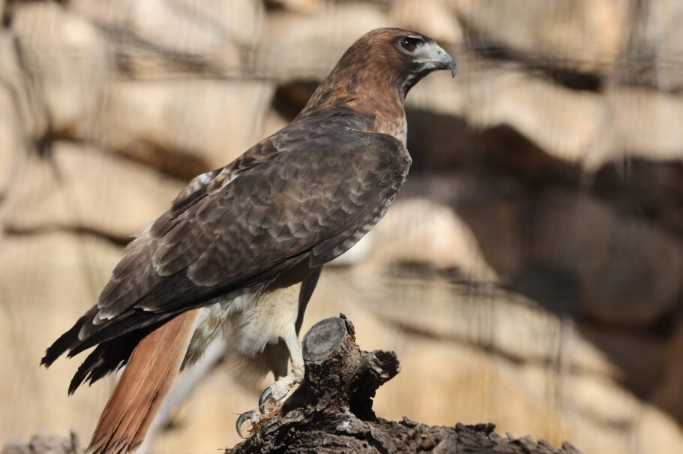
There's also the infamous "Krider's" Red-tailed Hawk, a pale, almost whitish variant found in the Great Plains. And let's not forget subspecies like the massive "Harlan's" Hawk from Alaska and northwestern Canada, which was once considered a separate species. Harlan's can have a tail that's mottled gray, white, or even marbled, not cleanly red. The American Ornithological Society's checklist, which you can browse on their website, has reclassified Harlan's as a subspecies of the Red-tailed Hawk, a perfect example of how our understanding of these Red-tailed Hawk characteristics evolves. It's a taxonomist's headache but a birder's delight.
| Plumage Type | Key Characteristics | Where & When | Common ID Pitfalls |
|---|---|---|---|
| Classic Light-Morph Adult | Rufous-red tail, dark brown back, pale belly with dark band, dark patagial mark. | Widespread across continent. Most common form in East. | Confused with Swainson's Hawk (slender, longer wings) or Rough-legged Hawk (has dark wrist patches, different shape). |
| Juvenile | Banded brown tail, pale eyes, more extensive streaking on belly and chest. | Everywhere, especially late summer through first spring. | Often mistaken for other Buteos like Broad-winged Hawk (much smaller, no belly band) or even Red-shouldered Hawk (checkered wings, longer tail). |
| Dark Morph | Mostly dark chocolate brown body, may show reddish tail. Patagial mark less visible. | Primarily western North America. More common in mountainous regions. | Can be confused with dark-morph Rough-legged Hawk (has distinct black belly, white tail base) or even a Common Raven in poor light (raven has wedge-shaped tail). |
| "Krider's" Variant | Extremely pale, often whitish head and tail, reduced belly band. | Great Plains region, especially in winter. | Might be misidentified as a Ferruginous Hawk (larger, more eagle-like, feathered legs) or even an albino. |
See what I mean? It's a spectrum. Relying on a single feature is a recipe for misidentification. You have to take in the whole picture.
How They Move: Flight and Behavior Patterns
You can often ID a Red-tail before you even see its colors clearly. Their flight style is distinctive. They are masters of the soar. On a sunny day, they'll find a thermal – a column of rising warm air – and circle within it with barely a wingbeat, gaining altitude effortlessly. Their wings are held in a slight dihedral (a shallow V-shape), but it's not as pronounced as in a Turkey Vulture. It's more relaxed.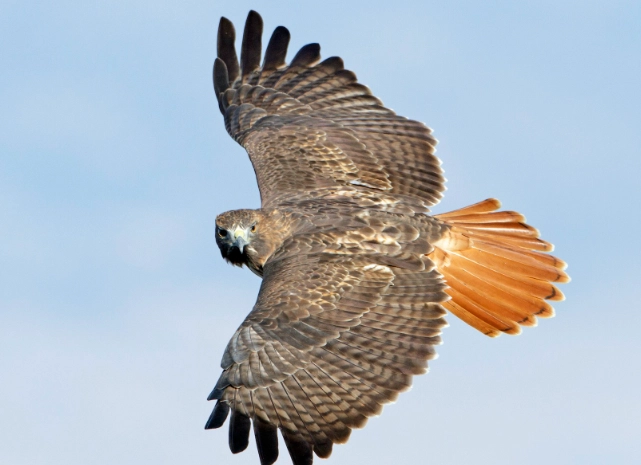
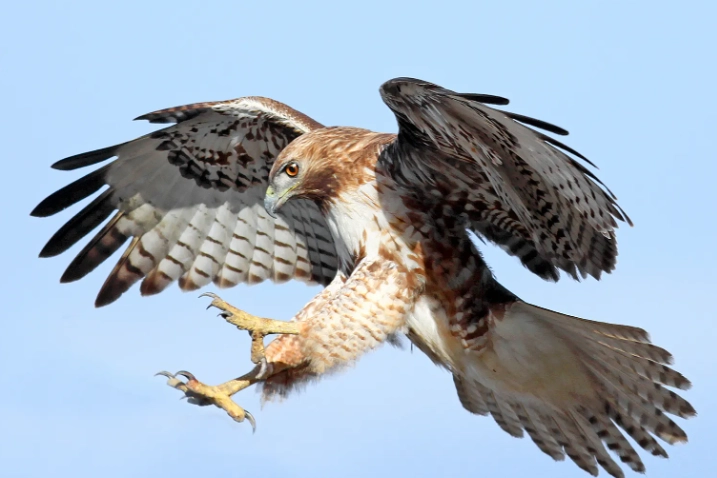
When they're not soaring, their flight is characterized by several strong, deep wingbeats followed by a glide. It's a purposeful, powerful flight, not the frantic flapping of an Accipiter like a Cooper's Hawk. Watching them hunt is a lesson in patience. They often use a "sit-and-wait" strategy, perched high on a tree, pole, or cliff edge, scanning the ground for movement. When they spot a vole, mouse, or snake, the attack is a swift, controlled descent.
I once watched one hunting over a frozen winter field. It would flap-hover, kestrel-style, for a few seconds before dropping. I was surprised – you don't read about that behavior as often. It just goes to show, even with a common bird, there's always something new to observe if you spend the time.
The Voice: That Iconic Scream (and Other Sounds)
Let's settle this. The loud, descending, hoarse scream – "keeeeer-r-r-r" – is the Red-tailed Hawk's call. It's the sound Hollywood slaps on any bird of prey scene. But in real life, they aren't constantly screaming. It's a call used in aggression, around the nest, or during courtship.
What do they sound like the rest of the time? They make a variety of chitters, peeps, and softer calls, especially between mates. Juveniles at the nest have a persistent, high-pitched begging call that sounds nothing like the adult scream. If you're interested in hearing the full range, the Cornell Lab of Ornithology's Macauley Library archive is an incredible, authoritative resource for bird sounds. Spending time listening there will tune your ear better than any description.
So next time you hear that scream in a movie with an eagle on screen, you can be the smug one who knows the truth. It's almost always a Red-tail.
Home and Habitat: Where to Find Them
Versatility is another core trait. Red-tailed Hawks are habitat generalists. You'll find them in just about any open or semi-open landscape that has some elevated perches and prey. This includes:
- Open Fields and Agricultural Land: Their absolute favorite. All those mice and voles in farm country make for a perfect buffet.
- Deserts and Grasslands: Where they often use rock outcrops or lone trees as perches.
- Woodland Edges and Roadsides: The classic highway pole perch. The road creates a clear sightline for hunting, and the poles are perfect perches.
- Even Urban and Suburban Parks: As long as there are some tall trees or buildings and enough green space with rodent activity, they'll move in. I've seen them nesting on window ledges of skyscrapers.
They are less common in dense, unbroken forest. They need those open spaces to hunt effectively. Their adaptability is a huge reason for their success.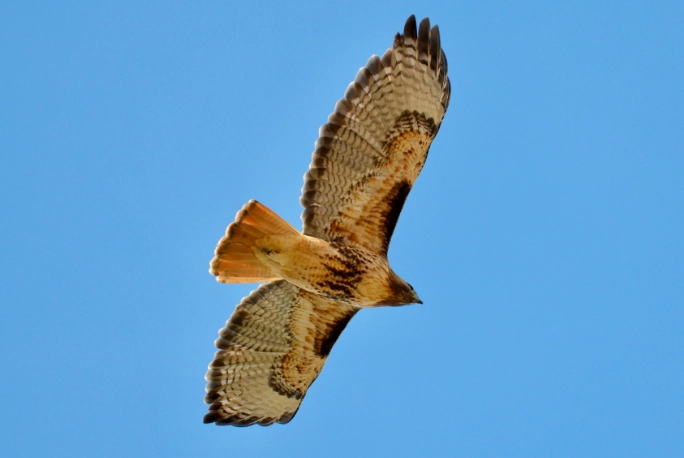
Diet and Hunting: What's on the Menu?
They are opportunistic predators, primarily small mammal specialists. The menu is heavily weighted towards rodents:
- Voles (often the #1 prey item in many areas)
- Mice
- Rats
- Squirrels (ground and tree)
- Rabbits
But they'll also take birds (like starlings or pigeons), snakes, lizards, and even insects or carrion when times are tough. Their hunting technique is usually that patient perch-hunting, but they also hunt from the air, soaring and then stooping. They have incredible eyesight – it's estimated to be 4 to 8 times more powerful than a human's. They can spot a mouse moving in grass from a hundred feet in the air.
A truly efficient natural pest controller.
Life Cycle and Reproduction
Red-tailed Hawks are monogamous and often mate for life, returning to the same general territory year after year. Their nests are massive, bulky platforms of sticks, lined with finer materials like bark strips and greenery. They typically build high in a tall tree, on a cliff ledge, or, increasingly, on human-made structures like cell towers.
The female lays 1 to 3 eggs (usually 2), and both parents share incubation duties for about 28-35 days. The young, called eyasses, are fluffy white at first. They grow incredibly fast and are ready to fledge (leave the nest) at about 6-7 weeks old. The parents continue to feed and care for them for several more weeks as they learn to hunt. Juveniles then disperse, facing the highest mortality rate in their first year as they learn the ropes.
Their Role in the Ecosystem and Conservation
Red-tailed Hawks play a critical role as apex predators in their ecosystems. By controlling rodent populations, they help maintain a balance, potentially reducing the spread of diseases and limiting agricultural damage from pests. They are a vital part of a healthy food web.
Thankfully, their conservation status is currently listed as Least Concern by the IUCN due to their large and stable population. This is a success story, especially when you consider the devastating effects DDT had on many raptors in the mid-20th century. The banning of DDT and legal protections under the Migratory Bird Treaty Act (which makes it illegal to harm, possess, or disturb them, their nests, or eggs without a permit) have been crucial to their recovery.
Current threats include secondary poisoning from rodenticides, habitat loss, and collisions with vehicles and windows. Using snap traps instead of poison for rodent control is a much safer choice for wildlife. Supporting land conservation efforts helps protect the open habitats they need.
They're a resilient bird, but not invincible.
Final Thoughts: Putting It All Together
So, what's the takeaway for identifying these hawks? Don't be a one-feature birder. The red tail is great when it's there, but it's just one piece of the puzzle. Build a mental checklist:
- Shape & Size: Bulky Buteo body, broad wings, short wide tail.
- Flight Style: Soars with wings in a slight V, deep wingbeats mixed with glides.
- Field Marks: Look for the dark patagial bar on the leading wing edge, the pale belly with a streaky band (in light morphs).
- Habitat & Behavior: Perched high overlooking open country, patient hunter.
- Voice: That raspy, descending scream (but remember, they're not always vocal).
Mastering these Red-tailed Hawk characteristics does more than just let you name a bird. It opens a window into the life of a truly magnificent and adaptable predator that shares our landscapes. The next time you see that sentinel on a pole, you'll see more than just a hawk. You'll see a master hunter, a devoted parent, and a survivor. And honestly, that makes every sighting a lot more rewarding.
Get out there, look up, and start seeing the details. You might be surprised at what you've been missing.
Reader Comments