Quick Navigation
So, you've spotted a nest in your backyard tree or under your eaves, and inside are those stunning, sky-blue eggs. You know they're American robin eggs – that color is unmistakable. But what's really going on in there? How did they get that color, how long until they hatch, and what should you do (or not do)? If you're curious, you're in the right place. I've spent years watching these birds, and I still find myself amazed by the whole process. Let's ditch the dry textbook stuff and talk about what makes these eggs and the birds that lay them so fascinating.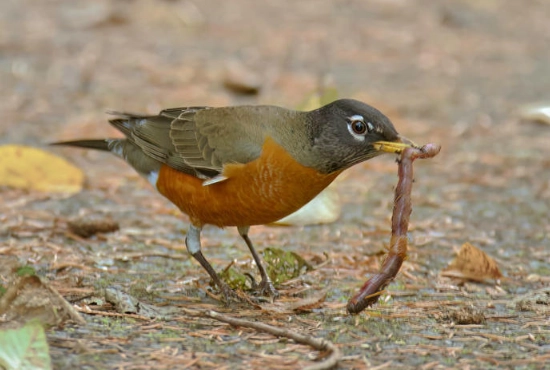
Honestly, robins can be terrible architects. I've seen nests on top of outdoor light fixtures, in hanging planters that get watered daily, and once, precariously balanced on a folded deck chair. But when it comes to the eggs themselves, they get it perfect every single time.
Key Fact: The iconic "robin's egg blue" isn't just for show. It plays a crucial role in temperature regulation and camouflage. The pigment responsible, biliverdin, is deposited onto the eggshell late in the shell-forming process inside the female robin.
What Do American Robin Eggs Look Like? The Nitty-Gritty Details
Everyone talks about the color, but there's more to it than just "blue." The shade can vary quite a bit. I've seen eggs that are a pale, almost powdery blue and others that are a deep, vibrant cerulean. It depends on the individual hen and even her diet. The eggs are usually a solid color, but sometimes you might see tiny, faint speckles. They're not glossy either; they have a matte finish that seems to absorb the light softly.
Size-wise, they're about what you'd expect for a bird of that size – roughly 1.1 to 1.2 inches long. They fit neatly in the palm of your hand. The shape is a classic ovate, slightly pointier at one end, which helps them roll in a tight circle instead of straight out of the nest. Smart, huh?
Here’s a quick breakdown of their physical characteristics. It’s useful for identification, especially if you're trying to tell them apart from other common backyard bird eggs, like bluebirds or starlings.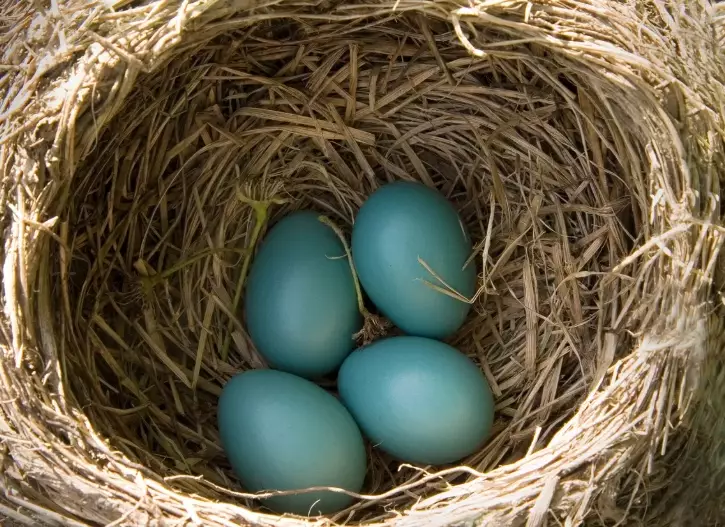
| Feature | Description | Why It Matters |
|---|---|---|
| Color | Unpigmented (white) base with an overlay of biliverdin, a bile pigment, creating shades from pale sky blue to a deeper greenish-blue. | The blue-green color may help regulate temperature by absorbing certain light wavelengths and can provide camouflage in dappled light. |
| Size | Approximately 2.8–3.0 cm (1.1–1.2 in) in length. | Perfectly sized for the female to incubate efficiently and for the nest cup built by the parents. |
| Clutch Size | Typically 3–5 eggs. The female lays one egg per day, usually in the morning. | This number represents a balance between reproductive effort and the parents' ability to feed all the chicks that hatch. |
| Eggshell | Calcium carbonate structure with thousands of microscopic pores for gas exchange. | Allows oxygen in and carbon dioxide out, which is vital for the developing embryo. |
Why blue, though? For the longest time, I thought it was just a random trait. But it's not. Research suggests the biliverdin pigment might actually be an indicator of the female's health. A brighter, more intense blue could signal to the male that she's a robust partner, encouraging him to stick around and help with feeding. It's a survival thing, wrapped in a beautiful package.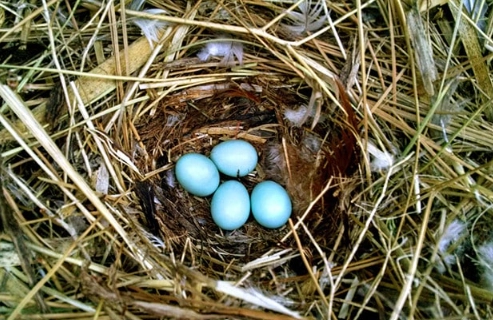
The Nest, The Wait, and The Big Hatch
You can't talk about American robin eggs without talking about the nest. It's a messy, sturdy cup made of grass, twigs, and mud, lined with fine, soft grass. The mud is what gives it structure – it's like avian cement. The female does most of the construction, molding the cup with her body. She'll often choose a location with some overhead cover, like a dense tree fork, a sturdy shrub, or yes, your porch light. The nest has to be just right to cradle those precious American robin eggs securely.
Once the final egg is laid, the real waiting game begins: incubation. The female is the primary incubator. She settles down on the nest, fluffing her feathers to create a perfect, warm pocket. Her body temperature and a special brood patch (a featherless area on her belly with extra blood vessels) transfer heat directly to the eggs. She'll only leave for short breaks to feed and drink. The male stands guard and might bring her food. This period lasts about 12 to 14 days. It's a tense time, vulnerable to predators and weather.
Did You Know? The female doesn't start full-time incubation until the last or second-to-last egg is laid. This is called "asynchronous hatching." It means the chicks hatch a day or so apart, which gives the first-born a size advantage. It's a harsh but effective strategy – if food is scarce, the smallest chicks might not survive, ensuring at least some make it.
Inside the egg, it's a frenzy of development. From a single cell, a complex chick forms, complete with a yolk sac for nourishment. You can find incredible, detailed day-by-day images of this process from the Cornell Lab of Ornithology's All About Birds project. It's mind-blowing to see.
The Hatching Timeline: What to Expect
If you're lucky enough to be observing a nest (from a respectful distance!), here's roughly how things unfold. Remember, this is nature, not a clock. A cold snap can delay things, and individual eggs can vary.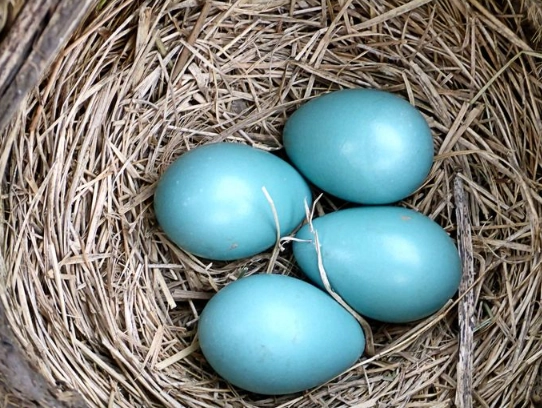
| Day Range | Stage | What's Happening |
|---|---|---|
| Days 1-5 | Early Development | Major organs and nervous system begin forming. The embryo is tiny. |
| Days 6-10 | Rapid Growth | Beak, wings, and feathers start to develop. The chick becomes bird-shaped. |
| Days 11-13 | Final Preparation | The chick absorbs the remaining yolk, positions itself for hatching, and begins to pip (peck) the shell from inside. |
| Day 12-14 | Hatching | The chick uses a special "egg tooth" on its beak to chip a circle around the shell. This exhausting process can take 12-24 hours. |
Hatching is hard work. The chick is using muscles it's never used before. You might hear faint peeping from inside the egg a day before it happens. When they finally emerge, they are wet, exhausted, and almost comically ugly – blind, mostly naked, and utterly helpless. But they're hungry immediately. Both parents spring into action, hunting for earthworms and insects to stuff down those gaping yellow mouths.
It's a messy, noisy, and completely miraculous transformation.
From Hatchling to Fledgling: The Chaotic Teenage Phase
The nest is now a crowded, bustling diner. The chicks grow at an unbelievable rate, fueled by a non-stop diet of protein. Their eyes open around day 5 or 6, and pinfeathers start to poke through their skin. In just about two weeks, they go from helpless blobs to fully-feathered, restless teenagers crowding the edge of the nest.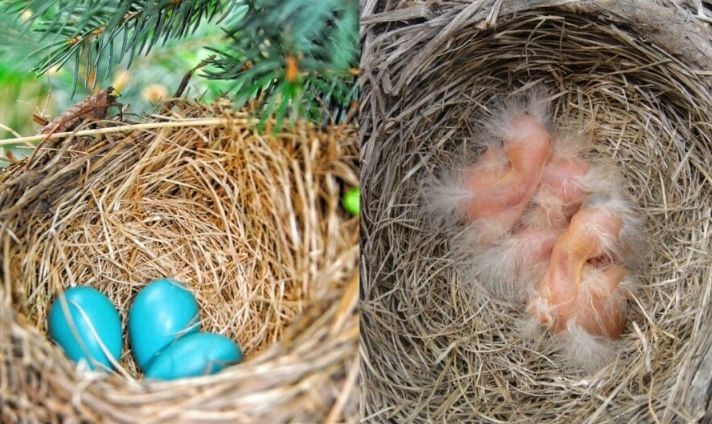
Fledging – leaving the nest – is a clumsy affair. They don't so much fly as hop, flutter, and tumble to the ground or a nearby branch. This is a super dangerous time. They're terrible flyers, loud, and obvious to predators. The parents continue to feed them on the ground for another few weeks, teaching them how to find food. If you see a speckled, short-tailed robin on the ground being pestered by adults, it's a fledgling. Leave it be! Its parents are nearby.
Important: If you find a baby bird with feathers on the ground, it's likely a fledgling. The best thing you can do is leave it alone or, if it's in immediate danger (like the middle of a road), move it a short distance to a sheltered shrub. Its parents are almost certainly watching and waiting for you to leave. Only featherless hatchlings found out of the nest need intervention. Contact a licensed wildlife rehabilitator. The U.S. Fish & Wildlife Service has resources, but your local state wildlife agency website will have direct contacts for rehabbers.
Common Threats to Robin Nests and Eggs
It's not an easy life for a robin egg. The odds are stacked against them from the start. Knowing the threats helps you understand why robins act so skittishly and why so many nests fail.
- Predators: This is the big one. Squirrels, snakes, crows, blue jays, and raccoons all love eggs. Cats are a massive threat to both eggs and fledglings. A well-hidden nest is a robin's best defense.
- Weather: A heavy rainstorm can flood a nest or chill the eggs if the mother is forced off for too long. Hail can physically damage eggs and chicks.
- Human Activity: This is where we often mess up without meaning to. Well-meaning "checks" on the nest can stress the parents and leave a scent trail for predators. Pruning trees or shrubs during nesting season can destroy active nests, which is often illegal under laws like the Migratory Bird Treaty Act.
- Parasites: Blowflies and mites can infest nests, weakening chicks by sucking their blood.
I once watched a blue jay systematically raid a robin's nest over two days. The parents were frantic, dive-bombing the jay, but they couldn't stop it. It was heartbreaking, but it's also part of the ecosystem. Blue jays have to eat too, and they're feeding their own chicks.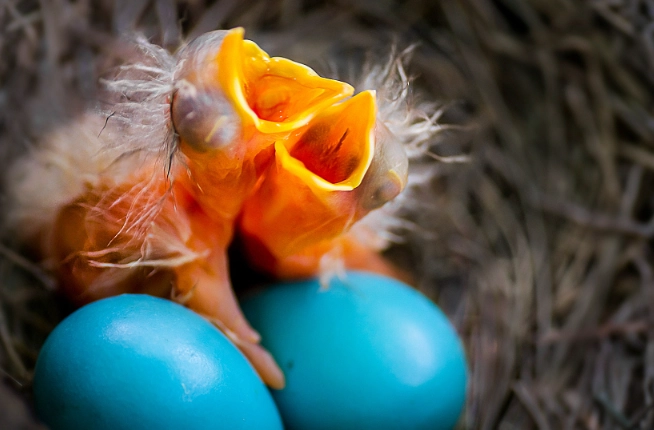
Your Role: How to Be a Good Robin Neighbor
So, you have a nest with beautiful American robin eggs in your yard. What now? Here’s a simple, practical list.
- Observe from Afar. Use binoculars. A good rule is to stay far enough away that the parents come and go without alarm calls or hesitation. Your presence should not change their behavior.
- Keep Pets Indoors or Leashed. Especially cats. It's the single biggest gift you can give your local birds.
- Postpone Yard Work. Hold off on trimming that bush or tree until you're sure the fledglings have left for good. It might look messy for a month, but it's a lifesaver.
- Provide Resources, Not Interference. A shallow bird bath for drinking and bathing is great. You can even offer mealworms in a dish during the busy chick-rearing period, but place it away from the nest so you don't draw attention to it.
- Don't "Rescue" Eggs. If you find an egg on the ground, it's almost certainly non-viable or was pushed out by the parents for a reason. It's nearly impossible to incubate and hatch a wild bird egg successfully without specialized equipment and permits.
Think of yourself as a quiet guardian, not a zookeeper.
Wrapping It Up: A Sign of Spring, A Lesson in Nature
Finding a nest of American robin eggs is one of the simple, profound joys of paying attention to the natural world right outside your door. That brilliant blue is a promise – of new life, of the changing seasons, of the relentless, messy, and beautiful cycle of nature. By understanding what you're looking at – from the chemistry of the shell to the tense two-week wait for a hatch – you become more than just an observer. You become a participant who can make choices that give those eggs, and the frantic parents tending them, their best shot.
Next time you see that familiar blue in a nest, you'll know the incredible story unfolding inside that fragile shell. You'll know the effort, the danger, and the pure instinct driving it all. And hopefully, you'll give them the space and respect they need to complete their mission. Just watch from the window, with a pair of binoculars handy. It's a show better than anything on TV.
Now, go listen for that cheerful robin song. They're probably talking about worms.
Answers to the Questions You're Probably Asking
Let's tackle some of the specific things people search for when they find these eggs.
Fun Fact: American Robins can have 2-3 broods per season, especially in the northern parts of their range. So after the first batch of robin eggs hatch and the chicks fledge, the parents might start the whole process over again in a new nest a few weeks later!
Reader Comments