You hear it every spring. From a wet ditch by the roadside, a tangle of shrubs at the park's edge, or that overgrown corner of your own backyard. A few sharp introductory notes, a quick trill, and a final, clear note. It's not the virtuoso performance of a mockingbird or the flute-like song of a thrush. It's something humbler, more persistent, and in its own way, more fascinating. It's the Song Sparrow, and if you've ever wanted to move past just "hearing a bird" to actually knowing it, this is your perfect starting point.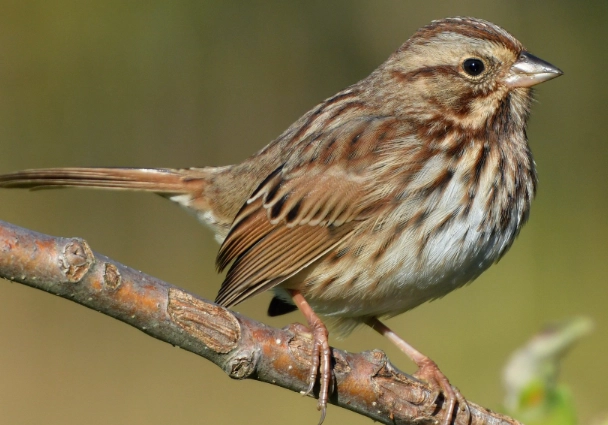
I've spent countless hours with these birds, from the coastal marshes of Maine to the chaparral of California. The mistake most beginners make? Dismissing them as just another "little brown job." That's a missed opportunity. The Song Sparrow is a masterclass in avian adaptation and individual expression. Let's get past the generic field guide entry and into what you really need to know to find, identify, and appreciate them.
Your Quick Guide to the Song Sparrow
What Does a Song Sparrow Look Like? (Spoiler: It's All About the Spot)
Forget color. The single most reliable field mark for a Song Sparrow is the messy, concentrated spot right in the center of its streaky breast. Think of an inkblot test, not neat rows of lines. The streaks radiate out from this central blob, forming what looks like a messy tie.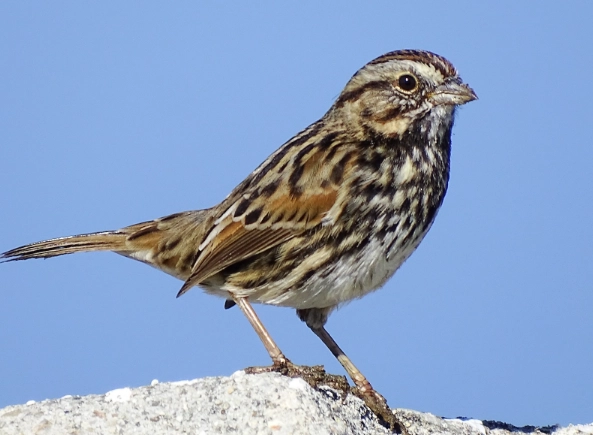
Here’s a breakdown to separate it from its sparrow cousins:
| Feature | Song Sparrow | Similar Bird (Savannah Sparrow) | Similar Bird (Lincoln's Sparrow) |
|---|---|---|---|
| Breast Streaking | Thick, messy streaks converging into a central dark spot or blotch. Streaks often extend down the flanks. | Thinner, neater streaks that usually do not form a single central spot. Often has a hint of yellow near the eye. | Extremely fine, crisp streaks on a buffy background that look "washed out." No central blotch. |
| Head Pattern | Grayish supercilium (eyebrow stripe) and crown with rusty brown stripes. A classic "striped head" look. | Often a paler, more yellowish eyebrow. Crown stripes less distinct. | Gray face with a crisp buffy eye-ring and mustache stripe. Looks more refined. |
| Tail & Posture | Long, rounded tail. Often pumps its tail in flight and when perched, a great behavioral clue. | Shorter, notched tail. Less frequent tail-pumping. | Tail-pumping is rare. Often appears more secretive and hesitant. |
Size-wise, they're a medium sparrow, chunkier than a Chipping Sparrow but slimmer than a cardinal. Their coloration varies wildly across North America—birds in the arid southwest are pale and gray, while those in the Pacific Northwest are dark and rufous. But that central breast spot? That's the constant. If you see that blotch, you're 95% of the way there.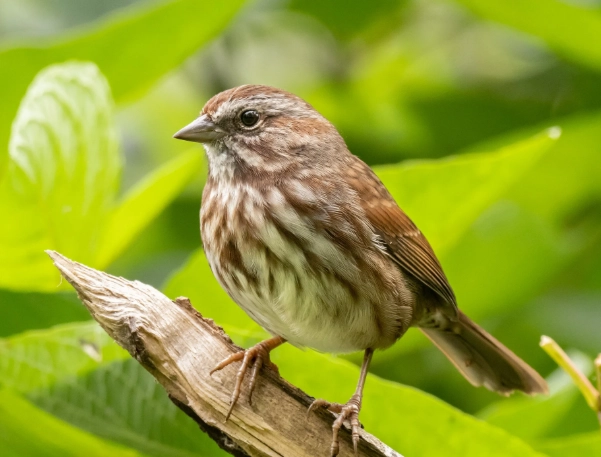
What Does a Song Sparrow Sound Like? (It's Not Just One Song)
This is where people get tripped up. You'll read that the Song Sparrow's song is "three short notes followed by a trill and a buzz" or something similar. That's a textbook simplification, and in the field, it can lead to confusion.
The reality is more interesting. Each male Song Sparrow has a repertoire of 6 to 12 distinct song types. He'll cycle through them. The classic pattern is indeed an introduction of 2-4 clear notes, a faster middle section (which can be a trill, a buzz, or a warble), and a distinct closing note or phrase.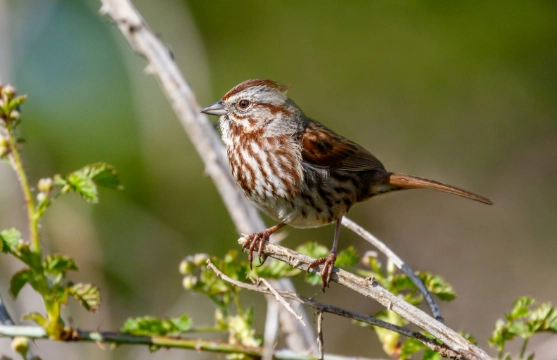
But here's the key nuance most guides miss: listen for the space between the sections. There's often a tiny, almost imperceptible pause between the intro and the middle, and again before the finale. It gives the song a structured, deliberate feel—"chip-chip-chew-chew-chew-trill-trill-trill...chip!"
Compare this to, say, a Chipping Sparrow's song, which is a long, dry, mechanical trill of one pitch with no breaks. Or a Dark-eyed Junco's trill, which is simpler and more musical. The Song Sparrow's song has grammar.
The best resource to train your ear is the Cornell Lab of Ornithology's Macaulay Library. Listen to a few dozen recordings from different regions. You'll start to hear the common architecture beneath all the variation.
Where Do Song Sparrows Live? (Think Messy, Not Pretty)
You won't find a Song Sparrow in a manicured lawn or a deep, dark forest. Their habitat preference is gloriously unkempt. They are edge specialists and lovers of dense, low vegetation.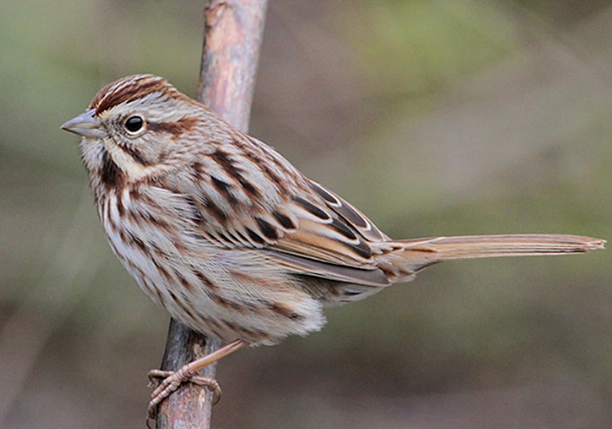
- Marshy edges with cattails and reeds.
- Overgrown fields with tall grasses and wildflowers.
- Brushy hedgerows between farm fields.
- The scrubby, brambly margins of streams and ponds.
- Overgrown garden edges, especially near a water source.
- Coastal dunes with beach grass and shrubs.
They need the cover for nesting and the open perches (a tall stalk, a fence wire, a small shrub) for singing. If you're looking for a pristine postcard scene, look elsewhere. If you're looking for a tangled, biodiverse thicket, you're in Song Sparrow territory.
Their range is vast, covering almost all of North America. They are year-round residents across much of the US, summer breeders in Canada, and winter visitors to the southern states and Mexico. This means for many people, they're a constant companion.
How to Find Song Sparrows: A Practical Plan
Let's get tactical. You want to see one. Here's a step-by-step approach based on my own missteps and successes.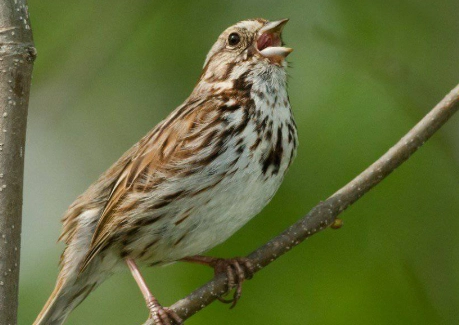
1. Pick Your Location and Time
Skip the city center. Head to a local park with a pond or stream, a nature reserve with old fields, or even a rail trail with brushy edges. Early morning, just after sunrise, is prime time. They sing most actively then to defend territory and attract mates. Late afternoon is a good second choice.
2. Use Your Ears First
Stop walking. Just listen for 2-3 minutes. Filter out the robins and cardinals. Listen for that structured, three-part song coming from low to medium height in the vegetation. Once you pinpoint the sound, move slowly toward it.
3. The Patient Scan
Don't expect the bird to be on the top of the tallest tree. Look about 1-6 feet off the ground. Scan the tips of tall grasses, the outer branches of a small shrub, or a fence line. Look for a small, brownish bird that flicks its tail. That tail-pump is a dead giveaway even before you see the breast.
4. A Pro's Trick for a Clear View
Song Sparrows are often skittish. If one flies deep into a bush, try this: make a soft, repetitive "pishing" sound (just say "pish-pish-pish" quietly through your teeth). Many small birds, including sparrows, are curious about this noise and will pop up to investigate. It doesn't always work, but when it does, it feels like magic.
I remember one soggy April morning in a state park. I'd heard a Song Sparrow for twenty minutes but only caught glimpses. I settled on a wet log, stopped trying so hard, and just watched the brush. After five minutes of stillness, he hopped onto an exposed root not ten feet away, gave his full song, and I could see every detail of that iconic breast spot. Patience, not pursuit, is the real skill.
Reader Comments