You're out in your yard or on a trail, and you hear it. A rapid-fire, complex series of notes, like a bird practicing its lines and then immediately contradicting itself. Two short phrases, then a pause. It's coming from a dense thicket, but you can't see a thing. Chances are, you've just had an encounter with a Brown Thrasher (Toxostoma rufum). This bird is the definition of "heard but not seen" for many beginner birders, and even some seasoned ones. I spent my first few years of birding thinking they were mythical creatures, until I learned where and, more importantly, how to look.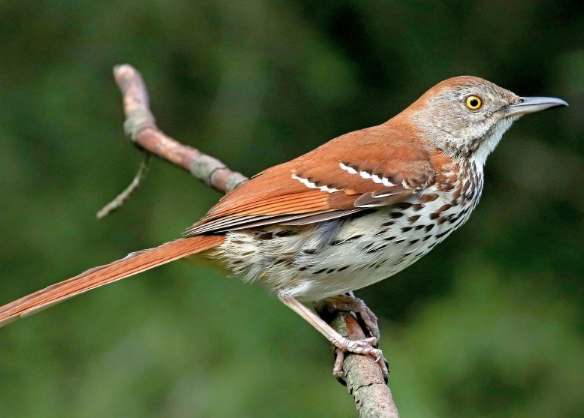
What's Inside?
How to Spot a Brown Thrasher (Before It Spots You)
Let's get the textbook description out of the way. The Brown Thrasher is a large, slender songbird, about the size of a Blue Jay but with a much longer tail. Its namesake color is a warm, rich rufous-brown on its back, wings, and tail. The underside is white or buffy, covered with heavy, dark brown streaks that look like someone flicked a paintbrush. Look for two key markers: bright golden-yellow eyes and a long, slightly downcurved bill.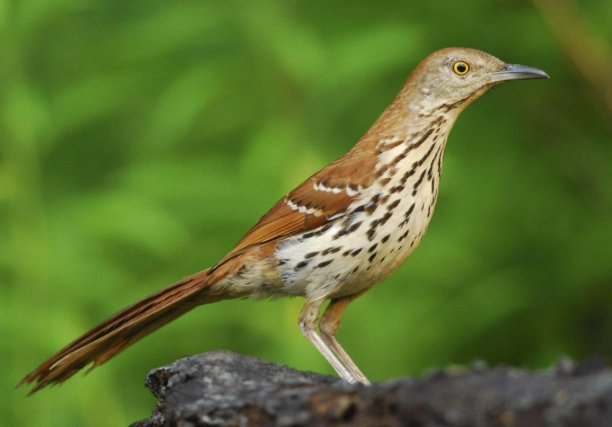
Here's the mistake I see constantly. People spot a streaky brown bird on the ground and immediately call it a thrasher. But several common birds share that profile.
| Bird | Key Differences from Brown Thrasher | Common Confusion Scenario |
|---|---|---|
| Wood Thrush | Smaller, rounder, with bold black spots (not streaks) on a clean white breast. Shorter tail. Lacks yellow eye. | Seen hopping in leaf litter in eastern forests. |
| Northern Flicker | Much larger, woodpecker shape. Black "bib," spotted belly. White rump patch visible in flight. | On the ground in open areas, often in pairs. |
| Female/Immature Brown-headed Cowbird | Smaller, sparrow-like bill, fine streaking, grayish-brown overall. Lacks the thrasher's rich color and long tail. | In mixed flocks on lawns or at feeders. |
The real giveaway isn't just the look; it's the posture. When a Brown Thrasher is on the ground foraging—which is most of the time—it has a distinctive, horizontal stance. It holds its body low and parallel to the ground, tail often cocked slightly, moving with deliberate, two-footed hops. It looks alert, almost cautious. A Wood Thrush looks more upright and delicate in comparison.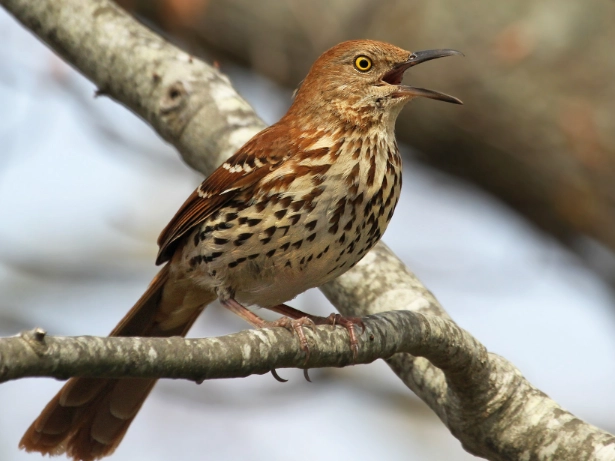
Where to Find Brown Thrashers: Their Favorite Haunts
This is the most critical piece of the puzzle. You won't find a Brown Thrasher in a pristine, open lawn or at the top of a tall pine. They are birds of the edge and the thicket.
Think about the messy, overgrown places we often ignore or clear away:
- The dense, brushy border between a field and a woodlot.
- Overgrown fence lines choked with blackberry brambles and wild rose.
- Regenerating clear-cuts or power line cuts with young saplings and shrubs.
- Your own backyard if you have a large, untamed shrub border or a pile of brush.
They need dense cover for nesting and hiding, but adjacent open ground (like short grass or leaf litter) for foraging. In the southeastern U.S., they're common year-round residents. Across much of the eastern and central U.S., they're summer residents, arriving in spring and leaving in fall. They winter primarily in the Southeast.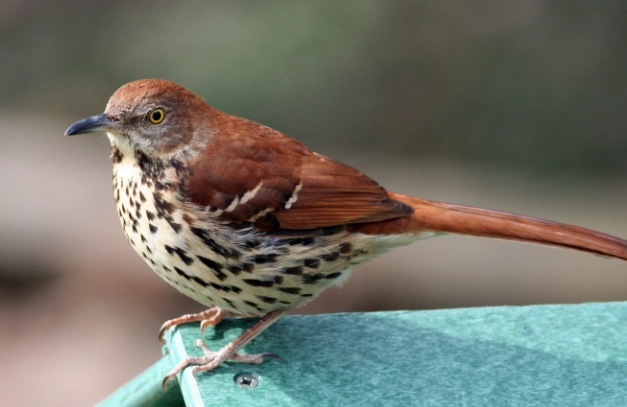
Timing matters, too. Your best chance for a clear view is during the breeding season (spring and early summer), especially when they have nestlings. The parents become bolder, making more frequent trips to and from the nest. Early morning is prime time for their most vigorous singing.
The Double-Song and Other Quirks: Understanding Their Behavior
The Song That Defines Them
If you remember one thing, remember this: Brown Thrashers typically sing each phrase twice. It's their signature. A Northern Mockingbird (a close relative) repeats phrases three or more times. A Gray Catbird (another relative) gives each phrase just once. The thrasher's song is a loud, flowing, seemingly improvised series of notes, with each musical idea delivered as a pair.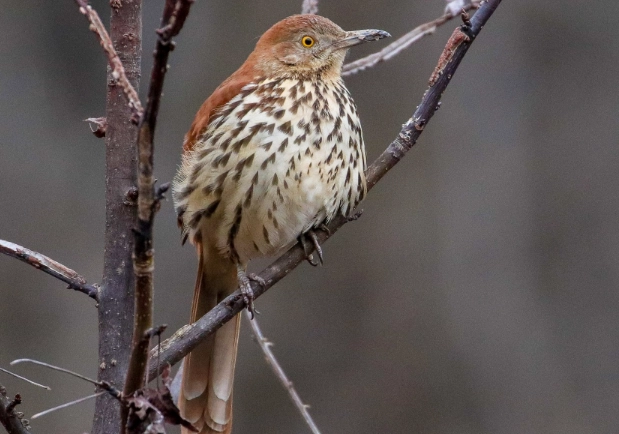
"Plant the seed, plant the seed. Dig it up, dig it up. Cover it, cover it. Wait and see, wait and see!" That's a silly human translation, but it captures the rhythm. Their repertoire is immense. According to research from the Cornell Lab of Ornithology, a single Brown Thrasher may know over 1,100 different song types, making it one of the most varied songsters in North America. They mimic other birds, frogs, even mechanical sounds.
Ground Foraging Experts
Watching a thrasher feed is a lesson in efficiency. They don't just peek at the ground. They use that long, strong bill as a tool, sweeping side-to-side through leaf litter to uncover insects, spiders, and seeds. They'll flip entire leaves over in a powerful motion. In late summer and fall, they become major consumers of wild fruits and berries—dogwood, sumac, pokeberry, you name it.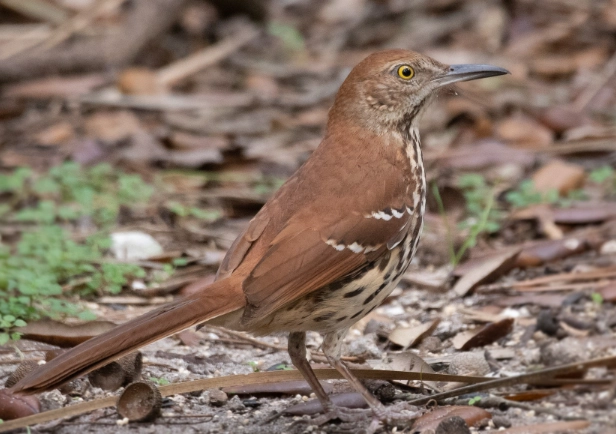
A Personal Observation: I once watched a thrasher in my Georgia backyard methodically clear a patch of ground under a wax myrtle. It would sweep, hop back, cock its head to listen, then lunge forward to grab a grub it had exposed. It repeated this for twenty minutes, completely focused. They're not just scratching randomly; it's a targeted, sensory hunt.
Nesting and Family Life
Their nests are bulky, often messy-looking cups of twigs, lined with finer roots and grass, usually placed low (1-7 feet high) in the densest part of a shrub or small tree. Both parents feed the young. And here's a defensive behavior few talk about: if a predator or curious human gets too close to the nest, the parents may perform a "broken-wing" display, fluttering along the ground as if injured to lure the threat away. It's a dramatic, brave act.
How to Attract Brown Thrashers to Your Backyard
Want to host one of these secretive songsters? You need to think like a property developer for shy birds. Offering food alone won't cut it. They need security first.
Step 1: Build the Habitat. This is non-negotiable. Dedicate a corner of your yard to becoming a thicket. Plant native, dense shrubs in clusters. Excellent choices include:
- Elderberry (food and cover)
- Dogwood (food and cover)
- Blackberry/Raspberry (the thornier, the better for protection)
- American Holly (year-round dense cover)
Leave a patch of leaf litter underneath these shrubs. Don't rake it clean. This is their foraging supermarket.
Step 2: Offer the Right Food. They are ground feeders. A platform feeder or even food scattered directly on the ground under your shrub border works best.
- Favorite Seeds: Sunflower seeds (shelled or chips), millet, cracked corn.
- Protein: Mealworms (live or dried) are an irresistible treat, especially during breeding season.
- Fruit: Chopped apples, raisins (soaked in water first), or berries.
Step 3: Provide Water. A ground-level birdbath or a shallow dish near the thicket edge is perfect. They are more likely to visit a bath that's close to cover.
Be patient. It might take a season or two for them to discover and trust your setup. The first time you see that long-tailed, streaky form hopping under your shrubs, you'll know it was worth the wait.
Are Brown Thrashers in Trouble?
According to the North American Breeding Bird Survey, Brown Thrasher populations have experienced a significant long-term decline, decreasing by over 30% since 1966. They are listed as a Common Bird in Steep Decline by organizations like Partners in Flight.
The primary culprit is habitat loss. Our obsession with tidy lawns, cleared fence rows, and monoculture agriculture eliminates the brushy, messy edges they depend on. Pesticide use reduces their insect prey. By creating habitat in your own space, you're contributing directly to the conservation of this remarkable species. You're not just getting a cool bird to watch; you're providing a refuge.
Your Brown Thrasher Questions, Answered
I always hear a Brown Thrasher singing in my bushes, but I can never see it. What am I doing wrong?
You're probably moving too much and looking too high. Find a comfortable spot 20-30 feet away with a clear view of the shrub's base. Sit still and be patient for 10-15 minutes. Use your ears—the song will often give away its general location. Scan the lower branches and the ground right at the edge of the thicket. They often perch to sing just inside the cover, not out in the open.
What does it mean when a Brown Thrasher sings all day long in spring?
It's primarily about territory and attracting a mate. That relentless singing in early spring is a male proclaiming "this thicket is taken." Once paired, the singing continues to strengthen the bond and warn off rivals. The peak of singing is at dawn, but they'll sing throughout the day, especially in the breeding season. It's a good sign of a healthy, established pair in your area.
Is a Brown Thrasher a type of mockingbird?
They're in the same family, Mimidae (the mimic thrushes), which includes mockingbirds and catbirds. So they're cousins, not the same species. Think of it like dogs: they're all canids, but a mockingbird is a fox and a thrasher is a coyote—related, but distinct in size, shape, and key behaviors (like the double-song vs. triple-song).
Will Brown Thrashers come to a suet feeder?
It's rare, but not impossible, especially in colder weather. They are primarily ground and low-shrub feeders. A suet cage attached to a tree trunk is usually outside their comfort zone. You'll have much better luck with platform feeders at ground level or just above it, stocked with their preferred seeds and mealworms.
Do Brown Thrashers migrate?
It depends on where they live. Populations in the southeastern U.S. are largely year-round residents. Those that breed in the northern parts of their range (the Midwest, Great Lakes, Northeast) migrate south to the Southeast for the winter. Their migration is often nocturnal and inconspicuous.
What's the biggest threat to Brown Thrashers in my neighborhood?
Beyond large-scale habitat loss, the local threat is over-management of land. The annual clearing of ditch banks, fence lines, and roadside brush destroys nesting sites and foraging areas in one go. Advocating for less frequent or more staggered clearing of these areas in your community can make a real difference. Also, keeping cats indoors is critical, as ground-nesting birds are extremely vulnerable.
Reader Comments