You're walking through a dense eastern woodland in spring, and you hear a high, piercing whistle: pee-teeeeeeeee! You look up, scanning the canopy. Nothing. It's a sound many birders know but a bird that remains frustratingly elusive for most. The Broad-winged Hawk (Buteo platypterus) is a master of the forest interior, a compact raptor whose spectacular fall migration contrasts with its secretive summer life. This guide isn't just a rehash of field guide facts. It's a practical manual born from years of missing them, then finally learning where and how to look.
What's Inside This Guide
How to Identify a Broad-winged Hawk
Forget trying to spot one perched deep in the woods from a distance. That's a recipe for frustration. Start with the contexts and shapes that give them away.
Size and Silhouette: The Stocky Buteo
Think of a buteo that's been compressed. They're noticeably smaller and more compact than a Red-tailed Hawk—roughly crow-sized. In flight, the wings are relatively short and broad (hence the name), and the tail is neatly squared-off or slightly rounded, not fan-shaped. When perched, they often look like a stout, barrel-chested bird, not the lanky, long-tailed silhouette of an accipiter like a Cooper's Hawk.
The Plumage Puzzle: Light Morph vs. Dark Morph
Most of the Broad-winged Hawks you'll see in the East are the light morph. Look for:
- Underparts: Clean white breast and belly, with crisp, horizontal rufous barring. This is a key mark. It's not streaking (like a Sharp-shinned Hawk) or a messy belly band (like some Red-shouldered Hawks). It's neat, like someone drew parallel lines with a brown marker.
- Head: A dark brown head that contrasts with a pale throat. They often have a faint dark "mustache" mark, but it's rarely as prominent as a falcon's.
- Tail: The tail is their billboard. From below, look for two or three bold, black-and-white bands. The outermost band is the widest and blackest. From above, the tail is dark brown with these same pale bands.
The dark morph is rare east of the Mississippi but more common in western populations. They are uniformly dark chocolate brown, but crucially, they still show those bold black-and-white tail bands in flight. If you see an all-dark buteo with a banded tail, you've likely got a dark-morph Broad-wing.
Pro Tip: Don't get hung up on the "broad wings" name when it's soaring high. At a distance, against the sky, all buteo wings look broad. Focus instead on the proportionally shorter wingspan and that distinctly banded tail. It's the tail that seals the deal.
The Flight That Gives Them Away
In active flight, their wingbeats are quick, stiff, and snappy. But the real magic happens during migration. They are thermal specialists. Watch a kettle of migrating hawks: the Broad-wings will be the ones forming the tightest, most cohesive clusters, circling in a seemingly coordinated ball within the thermal. They look like a swirling cloud of insects. Red-tails and other larger buteos often kettle more loosely.
The Sound: Your Ear is Your Best Tool
That high, thin, whistled pee-teeeeeeeee! (lasting about 2-3 seconds) is unmistakable once you know it. It's their primary call, used year-round. During the breeding season, listen for it near wet woodlands. It cuts through the forest noise better than any visual cue. The Cornell Lab of Ornithology's Macaulay Library has excellent recordings to train your ear.
Where and When to See Broad-winged Hawks
Their calendar dictates your strategy. Get this wrong, and you'll be looking in empty woods.
Summer (Breeding Season): May - August
They are birds of mature, uninterrupted deciduous or mixed forests, often near water—swamps, streams, beaver ponds. They avoid open areas for nesting. Your best bet is to listen first. Drive or walk along backroads bordering large forest tracts in the morning. Stop every half-mile, get out, and listen for that whistle. In my experience, a pair often has a favorite perch along a forest edge near water, from which they call.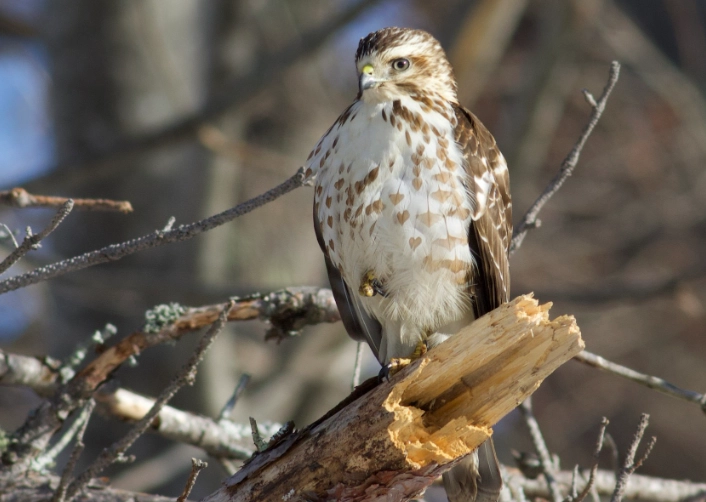
Key regions: The entire eastern deciduous forest biome from the Great Lakes south to the Gulf states, and across the northeastern U.S. and southern Canada.
Fall Migration (The Big Show): September - October
This is when they become a crowd-pleaser. They migrate in massive flocks called "kettles," sometimes containing thousands of birds. They follow mountain ridges and coastlines, using thermals. To see this, you need to go to a dedicated hawk watch site.
Top Migration Hotspots:
- Hawk Mountain Sanctuary, Pennsylvania: The classic. The first two weeks of September are peak. The view from the North Lookout over the Kittatinny Ridge is legendary.
- Cape May Point, New Jersey: A coastal bottleneck. Late September to mid-October. Birds funnel down the peninsula, often providing close, low-altitude views.
- Duluth, Minnesota (Hawk Ridge): For the Midwest, this is the spot. Mid-September sees huge numbers as they follow the Lake Superior shoreline.
- Veracruz River of Raptors, Mexico: The grand finale. Millions pass through here, creating one of the most spectacular wildlife phenomena on the planet in October.
The peak single-day counts at these sites can exceed 20,000 birds. Check site-specific forecasts from the HawkCount network.
Winter: Mostly Absent
Nearly all Broad-winged Hawks vacate the U.S. and Canada for Central and South America. A tiny handful may overwinter in extreme south Florida. Don't waste time looking for them in northern woods in January.
The Gear You Actually Need for Hawk Watching
You don't need a $3,000 spotting scope to enjoy Broad-wings. In fact, for migration watching, it's often the wrong tool.
Binoculars (8x42 or 10x42): This is your workhorse. For scanning the forest edge in summer or following individual birds in a kettle, binoculars are perfect. I prefer 8x for the wider field of view when tracking flying birds. A good mid-range pair from Vortex or Nikon is more than sufficient.
Spotting Scope (Optional for Migration): If you're at a hawk watch like Hawk Mountain, a scope on a tripod is great for studying distant kettles or identifying other raptor species. But for the Broad-wing spectacle itself, you'll spend more time looking with your naked eye or binoculars at the swirling masses overhead.
Clothing: This is critical and often overlooked. Migration happens on windy ridges in early fall. Dress in layers—a windproof shell is essential. Bring a hat, sunglasses, and more water than you think you need. Sitting still for hours on an exposed rock is colder than you expect.
The Best Piece of Gear: Patience. Hawk watching is waiting. Bring a camp chair, some snacks, and settle in. The birds come in pulses, not a constant stream.
Beyond the Basics: A Deep Dive into Broad-winged Hawk Behavior
The Migration Strategy: Efficiency Over Everything
Why do they kettle in such huge groups? It's all about energy savings. A study cited by the National Audubon Society suggests that by flying in a thermal together, individuals reduce their energetic cost of flight. They are masters of using rising warm air, often migrating only during the core midday hours when thermals are strongest, unlike falcons that fly more directly. This is why a sunny day after a cold front is the absolute best time to go to a hawk watch.
Nesting: The Hidden Life
Their nests are notoriously hard to find. They build a stick platform high in a deciduous tree, often near the trunk in a major fork. The clutch is usually 2-3 eggs. Both parents feed the young, bringing a diet dominated by small mammals (voles, mice, chipmunks), frogs, and insects. I once spent three weeks trying to pin down a nesting pair in upstate New York, only to realize their nest was in a beech tree so dense it was invisible until the leaves fell in November.
Diet and Hunting: The Opportunist
They are versatile. While small mammals are a staple, they are famous for their taste for amphibians, especially during frog breeding seasons in woodland ponds. They'll also take large insects, snakes, and occasionally small birds. They hunt from a perch, dropping down on prey, or sometimes walk on the ground in search of bugs and worms—a behavior more typical of a Buteo than an accipiter.
Common Mistakes and How to Avoid Them
I've made these, and I see others make them every season.
| Mistake | Why It Happens | The Fix |
|---|---|---|
| Calling every small brown raptor a Broad-wing | Especially with immature birds, which can be confusing. Young Red-shouldered Hawks are similarly patterned. | Focus on the tail bands and the clean, barred underparts. A Red-shouldered will have more streaking, a longer tail, and translucent "windows" near the wingtips in flight. |
| Looking for them in open country in summer | We associate hawks with open skies. Broad-wings are forest interior birds when breeding. | Change your habitat focus. Listen in mature woods, not over fields. |
| Giving up on a hawk watch too early | Migration is weather-dependent. A slow morning can explode after 11 AM when thermals develop. | Commit to a full day, especially on a promising weather day (NW winds after a front). The main movement often happens between 10 AM and 2 PM. |
| Misjudging the dark morph | An all-dark hawk is confusing. It's easy to jump to Rough-legged Hawk (in winter) or dark-morph Red-tail. | Remember the tail. That bold black-and-white banding is the Broad-wing's signature, even on the dark morph. Rough-legged has a dark tail with a white base; dark Red-tails lack the crisp, even banding. |
Your Broad-winged Hawk Questions Answered

Reader Comments