
I bought my first spotting scope eight years ago after a heron trip went sideways — the guy next to me read a leg band from 200 yards while I squinted through 10x42 binoculars and saw a blurry stick. That day pushed me into a decade of switching between both tools, and I've since learned most buying advice gets one thing wrong: it treats them as competitors. They solve different problems. If you're stuck deciding, the short answer is this — binoculars win for walking and quick scanning; spotting scopes win for parked, long-range detail. Keep reading, because the choice gets messier than that.
What's inside this field guide
The Core Difference in Real Field Use
Forget the spec sheet for a second. A spotting scope is a small telescope on a tripod. You plant it, you point it, you study. Binoculars are two tubes you hold to your eyes and sweep across a scene. That's the whole philosophical split. Everything else — magnification, objective lens size, weight — flows from that one design choice.
Here's what that means at the trailhead. With binoculars, I can be looking at a warbler in under two seconds. With a scope, I need to set the tripod down, level it, find the bird with a low-power eyepiece, then zoom in. That process takes me about 25–40 seconds on a good day. On a windy day on a cliff edge, it can take longer than the bird stays put.
The trade-off is image quality at distance. A good 60mm spotting scope at 30x will resolve feather detail on a duck at 300 yards. Your 10x42 binoculars will show you a duck-shaped silhouette. Whether that detail matters depends entirely on what you're doing.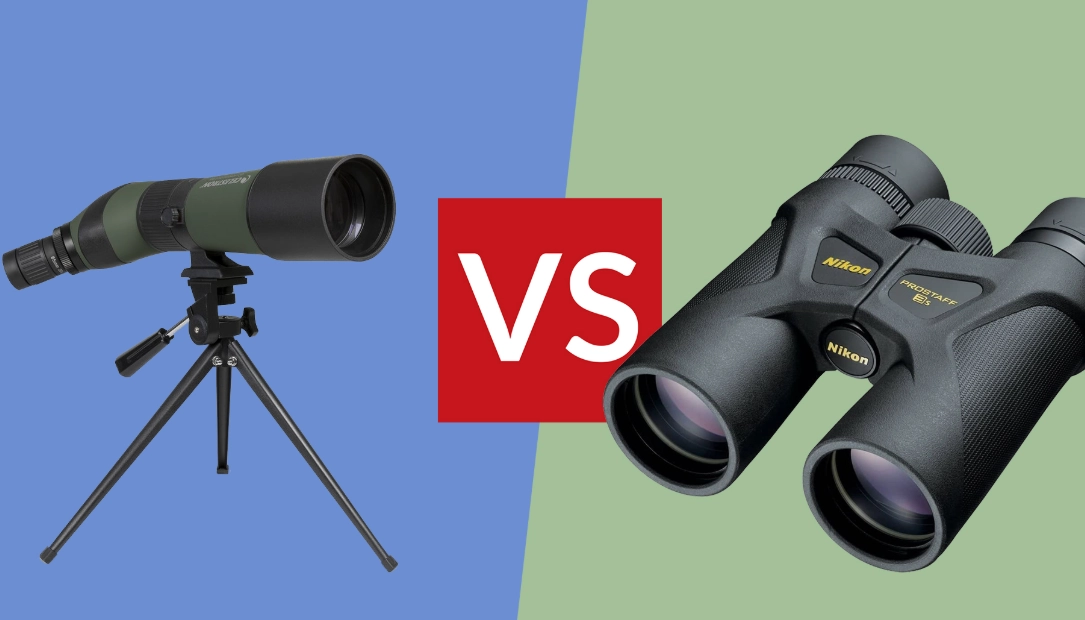
When Binoculars Are the Smarter Buy
If you hike more than a mile to your birding spot, binoculars win. No debate. My 8x42 pair weighs 27 ounces and hangs around my neck all day without complaint. My 65mm scope plus tripod weighs just over 5 pounds, and I feel every ounce on switchbacks above 8,000 feet.
Binoculars also handle rain better in practice. I've been caught in sudden Sierra storms, and my roof-prism binoculars shake off water with a quick wipe. Scope eyepieces collect fog and dust in the crevices around the zoom ring. Not a dealbreaker, but an annoyance you notice after the third wet outing.
- Quick scanning: Pine grosbeaks flitting through a spruce stand? Binoculars. You need wide field of view, not zoom.
- Mixed terrain: If your walk moves from open marsh to dense willow thickets, binoculars adapt faster than any tripod setup.
- Group outings: Sharing binoculars is easy. Sharing a scope means everyone takes turns adjusting the tripod height and diopter — kills the mood.
- Budget under $400: You can get a genuinely good pair of 8x42 or 10x42 binoculars for $300–$400. A scope at that price usually means a wobbly tripod and chromatic aberration at high zoom.
One non-consensus take: don't buy 12x binoculars thinking you'll get scope-like reach. The shake at 12x without stabilization is real, and you lose field of view. I tried a 12x50 pair for a season and went back to 10x42. The extra magnification bought me nothing but a narrower view and a headache.
When a Spotting Scope Earns Its Weight
Scopes shine when your feet stop moving. Shorebird surveys from a fixed dike. Raptor counts from a hawk watch platform. Lake watching for loons and grebes. Any scenario where you sit or stand in one place and work a distant area.
I keep a 65mm angled scope for coastal trips. Last spring at a estuary mudflat, I counted 14 species of shorebirds in an hour without moving from my folding stool. The birds were 80–150 yards out. Through binoculars I'd have identified maybe six confidently. The scope showed bill shape, leg color, and feeding motion — the stuff field guides tell you to look for but don't mention you need 30x to see.
Digiscoping is another angle. Holding a phone to a scope eyepiece gets you decent record shots of distant birds. I've gotten identifiable photos of a Pacific loon at 200 yards with a $20 phone adapter. That's not happening with binoculars and a phone.
Angled vs straight eyepiece — the old debate. I use angled because it saves my neck during long watches, and it lets shorter birders share the view without cranking the center column down to knee height. Straight eyepieces are easier to aim initially. If you mostly scan flat terrain, straight works fine. If you look up at ridges or share with kids, go angled.
Head-to-Head Comparison Table
| Feature | Binoculars (8x42 / 10x42) | Spotting Scope (60–80mm) |
|---|---|---|
| Typical magnification | 8x to 10x | 20x to 60x (zoom eyepiece) |
| Weight | 25–30 oz | 4–6 lbs with tripod |
| Setup time | 2 seconds | 25–40 seconds |
| Field of view at 100 yards | 330–390 feet | 60–120 feet (varies with zoom) |
| Best use case | Active walking, forest birding, quick scans | Stationary watches, shorebirds, raptors, digiscoping |
| Minimum good budget | $300 | $600 (scope + tripod) |
| Eye strain over 2 hours | Low | Moderate — single-eye viewing tires you faster |
The eye strain point deserves a note. Using one eye through a scope for two hours straight gives me a dull ache behind the eye. I started keeping the non-viewing eye open instead of squinting it shut, and that helped. Some birders use an eye patch. Not glamorous, but honest.
Mistakes I See Beginners Make
Buying a scope before learning binoculars
The number of people who show up to a hawk watch with a brand-new scope and no binoculars is higher than you'd think. You need binoculars to find the bird first. A scope at 20x has such a narrow view that locating a moving bird through it is painful. Scan with binoculars, then switch to the scope for detail. That's the workflow.
Skimping on the tripod
A $900 scope on a $60 tripod is a waste. The head wobbles in wind, and at 45x every vibration shows. Budget at least 30% of your total spend for a fluid head tripod. I learned this after a cheap pan head drifted mid-view and I lost a rare gull identification.
Ignoring the zoom eyepiece quality
Many scopes ship with a zoom eyepiece that's soft at full magnification. Read reviews specifically about the eyepiece, not just the body. A fixed 30x wide eyepiece often beats a cheap 20–60x zoom for sharpness, and it's brighter at dusk.
Field Questions I Actually Get Asked
Can I get away with only a spotting scope for forest birding?
Forest birding with only a scope is rough. The canopy is close, birds move fast, and the narrow view makes tracking warblers frustrating. You'll spend more time repositioning the tripod than watching birds. A scope works in forests for stationary owls or nest watches, but for general woodland birding, binoculars are the tool. If you must carry one optic, make it binoculars.
How much magnification do I actually need on a scope for shorebirds?
Most of my shorebird work happens between 25x and 40x. Pushing to 60x on a 60mm scope dims the image and softens detail unless you're in crisp morning light. A 65mm or 80mm scope holds up better at high zoom. If shorebirds are your main target, prioritize objective lens size over maximum zoom number. Brightness beats magnification at distance.
Do image-stabilized binoculars replace a spotting scope?
They close part of the gap, not the whole thing. Stabilized 14x or 16x binoculars let you see detail at 100 yards that standard 10x misses. But at 300 yards, a 30x scope still wins on resolution. The stabilized binoculars are brilliant for scanning from a boat or windy ridge, though. If I could only own two optics, I'd take stabilized binoculars and a 65mm scope.
What's the minimum budget for a scope setup that won't frustrate me?
Realistically, $600 to $800 for scope plus tripod. Below that, you're fighting soft glass at high zoom or a tripod that drifts. The sweet spot for most birders is a 65mm or 80mm scope in the $500–$700 range with a $150–$200 fluid head tripod. Buy used if you can — scopes hold up well, and the savings go toward a better tripod.
My honest bottom line after years of carrying both: Start with binoculars. Learn to find birds quickly, learn field marks, learn patience. Add a spotting scope when you notice yourself saying "I can see it's a shorebird but I can't tell which one" on a regular basis. That's the signal. The scope doesn't replace binoculars — it extends what you can do once you've stopped moving.
Field notes verified against manufacturer specifications and personal observation logs from coastal and mountain birding trips.
Reader Comments