Let's be honest. The ruby-crowned kinglet (Regulus calendula) is the bird that makes even experienced birders question their eyesight. You're standing in a quiet conifer forest, hearing a rapid, high-pitched chatter, scanning the dense foliage... and seeing nothing. Then, a blur of olive-gray zips from one branch to another, a tiny hint of movement against a million green needles. That's your kinglet. It's not just a bird; it's a challenge, a reward for patience, and one of the most energetic characters in North American woodlands. This guide cuts through the frustration and gives you the exact tools to find, identify, and appreciate this minuscule dynamo.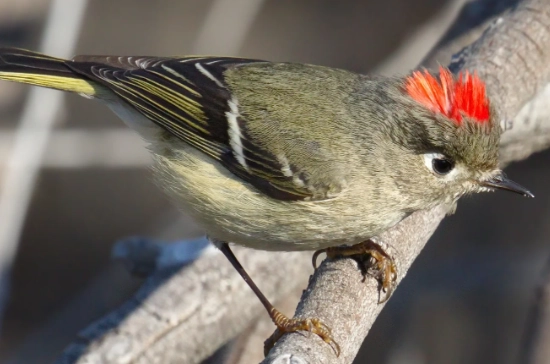
Your Quick Guide to the Ruby-Crowned Kinglet
What Does a Ruby-Crowned Kinglet Look Like?
Forget the "ruby crown" for a second. That's the party trick, not the everyday ID. Most of the time, you're looking at a bird that's smaller than a chickadee, almost spherical, and seemingly made of nervous energy.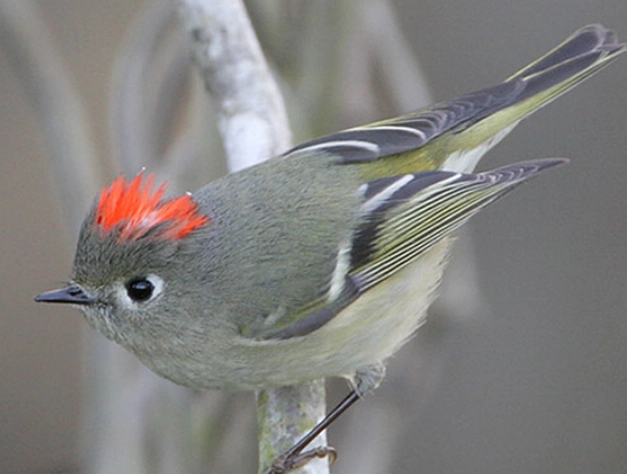
The Standard Uniform: Overall, it's olive-gray on the back and head, with a pale, almost whitish underside. It has a prominent white eye-ring that gives it a surprised, alert look—a key field mark. The wings are dark with two white wing bars, and there are often pale yellow edges on the flight feathers. It constantly flicks its wings, a quick, jittery movement that's a dead giveaway.
Females look identical to males but lack the ruby crown (though they have the same basic structure). Juveniles are similar but duller. The overall impression is a tiny, plump, hyperactive ball of feathers with big, dark eyes surrounded by white.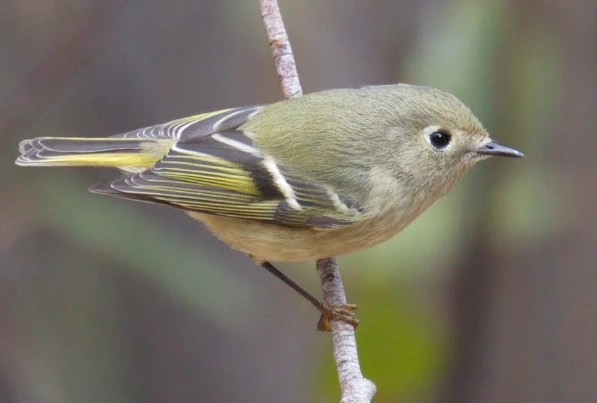
Mastering the Ruby-Crowned Kinglet Call
Your ears will find this bird long before your eyes do. Sound is non-negotiable for kinglet identification.
The most common call is a harsh, scolding "ji-dit" or a rapid, chattering "ji-dit, ji-dit, ji-dit." It's often described as sounding irritable. This is what you hear as it flits through the trees foraging.
The song is a different beast entirely—and one of the great wonders of the bird world. It starts with a few high, thin see notes, then launches into a loud, complex, tumbling warble: "see-see-see, chew-chew-chew, chip-chip-chip, choo-choo-choo." It's astonishingly loud for such a small bird. You hear this primarily during spring migration and on the breeding grounds. I remember first hearing it in a Colorado spruce forest and refusing to believe such a big sound came from a 6-gram bird. I was wrong.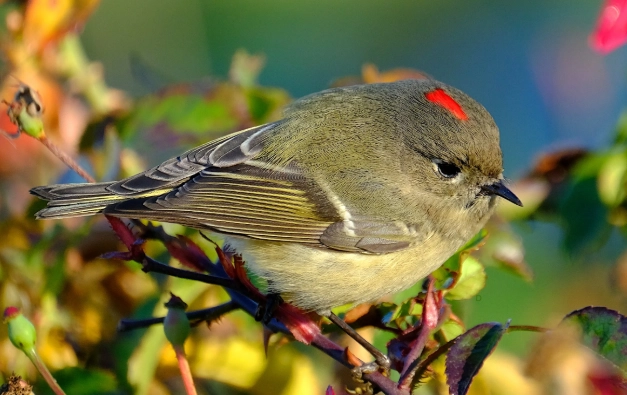
Compare it to the golden-crowned kinglet's song, which is a high, thin series of see notes that rise in pitch and then drop: "see-see-see-see, ti-ti-ti-ti, see-see-see-see." No complex warble. This distinction is critical.
Habitat & Where to Find Them
Ruby-crowned kinglets are birds of dense, scrubby, or coniferous woodlands. Their habitat preferences shift with the seasons, a detail many basic guides gloss over.
Breeding Season (Spring/Summer): Head north and up. They breed across Canada, Alaska, and the western U.S. mountains (like the Rockies, Sierra Nevada, Cascades). Here, they love mature coniferous forests—spruce, fir, pine—and mixed forests with a heavy conifer component. They often nest in dense, young spruce or fir thickets.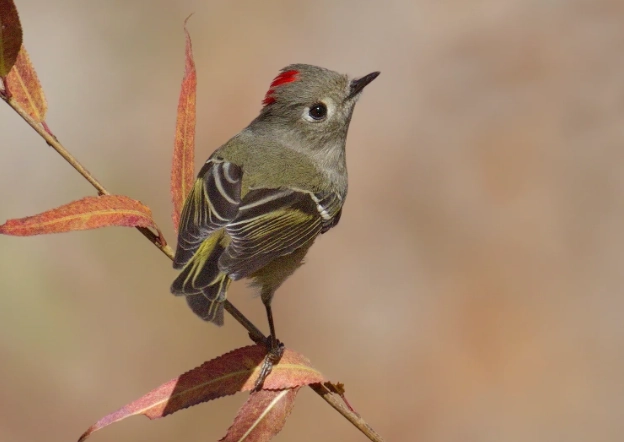
Migration & Winter (Fall/Winter): This is when most people in the Lower 48 see them. They fan out across much of the United States and into Mexico. Their winter habitat is more varied. You'll find them in:
- Deciduous woodlands (oak, maple)
- Riparian corridors (streamside forests)
- Parks, cemeteries, and suburban areas with mature trees
- Scrublands and pinyon-juniper woods in the Southwest
The key is thick cover. They avoid open fields and pure, park-like lawns. Look for the tangles, the brush piles, the dense middle story of a forest. During a winter bird count in central Texas, I found a flock of six working a live oak motte surrounded by cedar scrub—perfect, protected foraging grounds away from the wind.
Behavior, Diet, and Breeding
Understanding how it lives explains where to look.
Diet: They are almost exclusively insectivores. In summer, they eat aphids, scale insects, caterpillars, and spiders. In winter, they supplement with small berries and tree sap. Their foraging style is hyperactive: they hover at the tips of branches, glean insects from bark and leaves, and make short, sallying flights to catch prey in mid-air. They often join mixed-species flocks in winter, tagging along with chickadees, titmice, nuthatches, and warblers. If you find a busy winter flock, scan the edges for the tiny, wing-flicking bird.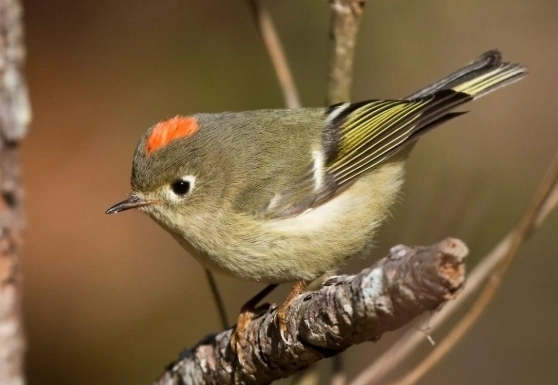
Breeding: They build an incredible, deep, hanging cup nest that is suspended from two conifer twigs high in a tree, often concealed by overhanging branches. The nest is made of moss, lichen, spider silk, and bark, and is so elastic it can stretch as the chicks grow. The female lays up to 12 eggs—one of the largest clutches relative to body size of any North American songbird. Both parents feed the young.
Ruby-Crowned vs. Golden-Crowned Kinglet: The Showdown
This is the most common point of confusion. They're similar in size and shape, but the differences are clear once you know them. Here's your cheat sheet: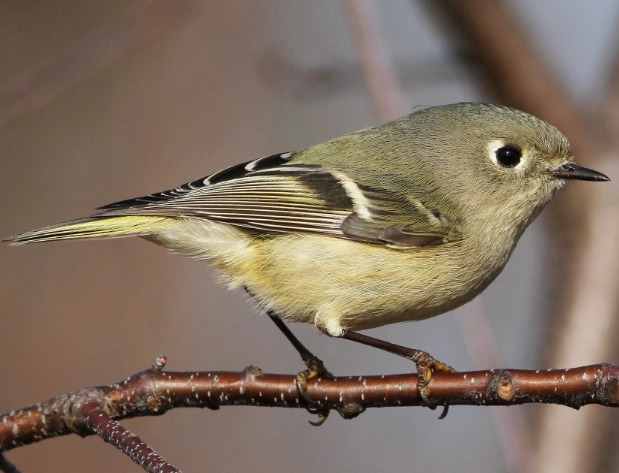
| Feature | Ruby-Crowned Kinglet | Golden-Crowned Kinglet |
|---|---|---|
| Face Pattern | Prominent broken white eye-ring. Plain face. | Strong black and white stripes on face. Black stripe through eye, white above it. |
| Crown | Male has scarlet central stripe (usually hidden). Female has plain crown. | Male has orange-yellow center flanked by bright yellow and black. Female has yellow center. |
| Underparts | Pale, dingy white to light gray. | Pale, but often with a more olive or buffy wash. |
| Call | Harsh, scolding "ji-dit." | High, thin, sibilant "see-see-see." |
| Song | Loud, complex, tumbling warble. | High, thin, rising and falling "see" notes. |
| Wing Flicking | Constant, pronounced. | Less frequent, more subdued. |
| Winter Habitat | More generalist: deciduous woods, scrub. | Strictly coniferous. Rarely leaves evergreens. |
The face pattern is the fastest tell. No face stripes? Think ruby-crowned. Bold black-and-white face stripes? That's a golden-crowned. Habitat is the second clue: a tiny kinglet in an oak tree in January is almost certainly a ruby-crowned.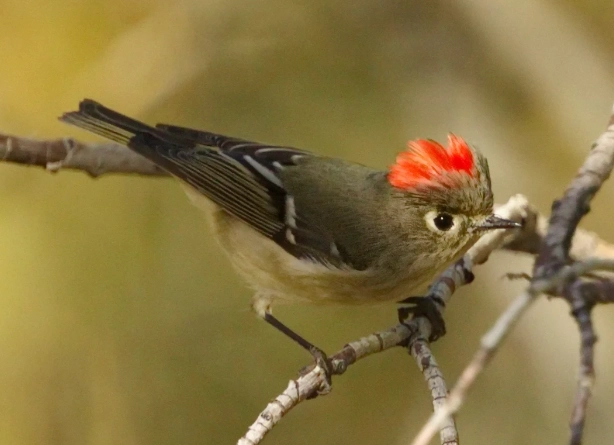
Pro Tips for Finding & Observing Them
Here's the practical, in-the-field advice you won't find in a field guide sidebar.
1. Listen First, Look Later. Stop walking. Stand still for two minutes. Let your ears map the soundscape. That chattering ji-dit is your homing beacon.
2. Scan the Middle Zone. Don't just look at the treetops or the ground. Kinglets often forage in the 5-15 foot range, in the smaller branches and outer foliage of trees and tall shrubs.
3. Use "Soft Focus." Don't try to pick out details immediately. Let your gaze relax and look for movement—the distinctive, frantic wing-flicking or a quick hop between twigs.
4. Pish Sparingly. Making pssh pssh sounds can sometimes bring curious birds closer. But with kinglets, it's hit or miss. A better tactic is to imitate their scolding call softly. A few ji-dit, ji-dit notes can trigger a response.
5. Timing is Everything. They are most active on calm, cool mornings. On windy days, they hunker down in the thickest cover and are nearly impossible to find. A crisp, sunny morning after a cold night is prime kinglet time.
6. Gear Up Right. A decent pair of 8x42 binoculars is ideal for gathering enough light in dim forests. Forget digiscoping with your phone for this bird—they move too fast. If you want a photo, you need a camera with a fast autofocus and a willingness to take hundreds of shots for one keeper. I've spent hours trying, often ending up with photos of empty branches.
Follow a mixed flock. Be patient. And remember, seeing the ruby crown is a bonus, not the goal. The goal is to witness that incredible, buzzing little life in the trees.
Your Kinglet Questions Answered
Why is the ruby-crowned kinglet so hard to photograph?
How can I attract ruby-crowned kinglets to my backyard?
Are ruby-crowned kinglets endangered?
What's the difference between a ruby-crowned kinglet and a Hutton's vireo?
Do ruby-crowned kinglets sing in winter?
Reader Comments